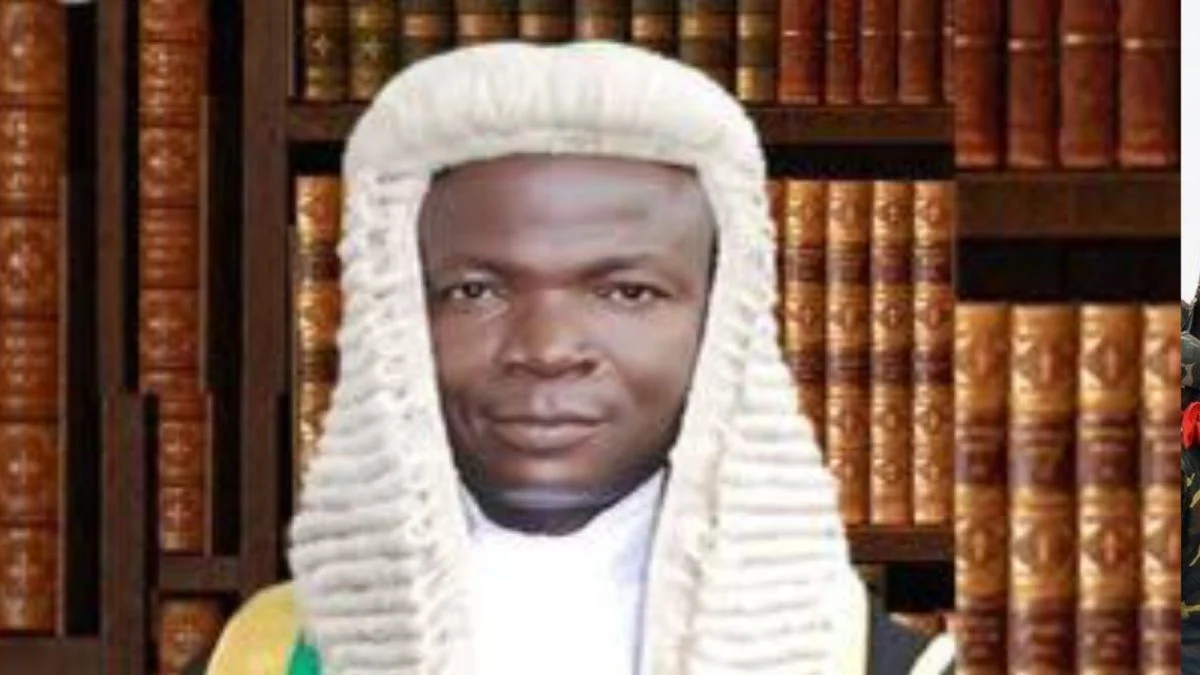
Justice James Omotosho of the Federal High Court in Abuja has withdrawn from the N10.27 billion alleged money laundering case involving Ali Bello, nephew of former Kogi State Governor Yahaya Bello.
The judge announced his decision on Thursday after raising concerns over the unresolved alleged tampering with evidence that had already been admitted in the trial.
Justice Omotosho said the issue had become particularly important because the affected evidence could play a significant role in determining the no-case submission filed by the defendants.
He subsequently directed that the case file be returned to the Chief Judge of the Federal High Court for reassignment to another judge.
The development came as the court was expected to hear arguments on the no-case submission filed by Bello and his co-defendant, Dauda Sulaiman.
The defendants are facing charges brought by the Economic and Financial Crimes Commission, EFCC, over an alleged N10,270,556,800 financial transaction involving funds said to have been withdrawn from the Kogi State treasury.
The prosecution had earlier concluded its case after calling 17 witnesses and tendering documentary evidence before the court.
The defence thereafter indicated that it would rely on a no-case submission, arguing that the evidence presented by the EFCC did not establish a prima facie case requiring the defendants to enter a defence.
However, the evidence-tampering controversy remained unresolved.
The issue came to light earlier in the year when Justice Omotosho disclosed that a registrar of the court, Nasiru Onimisi Zubairu, had allegedly been approached by Sulaiman to delete WhatsApp messages from a mobile phone that had already been admitted as evidence.
The judge had ordered the Department of State Services, DSS, and the Nigeria Police Force to investigate the allegation.
The registrar was also asked to appear before the court and explain what had happened.
During the proceedings, Zubairu reportedly told the court that Sulaiman approached him after he complained about his accommodation difficulties.
According to the registrar, the second defendant asked him to delete some WhatsApp messages contained in the exhibits and promised to provide him with a house.
“He then asked me to delete some information, some WhatsApp messages in the exhibits, and promised to give me a house,” the registrar told the court.
Justice Omotosho subsequently played the registrar’s recorded statement in open court and directed further examination of the affected evidence.
The judge had explained that he was required to disclose the matter after receiving a directive from the Chief Judge concerning the early disclosure of incidents capable of affecting the integrity of proceedings.
“I have to disclose it because that is what the chief judge told us, to ensure we disclose such a thing as early as possible,” Justice Omotosho said.
He added: “We have zero tolerance for this kind of attitude. The person involved is here. I will call him so that you will hear from the horse’s mouth.”
An EFCC investigator, Muhammed Audu Abubakar, was subsequently asked to examine the phone and compare its contents with the extracts already before the court.
The investigator confirmed that several WhatsApp conversations contained in Exhibits N and O were no longer available on the device.
The missing conversations reportedly covered different dates between 2020 and 2022.
Among the messages said to have disappeared were conversations relating to alleged payments and movements of money.
The prosecution also drew the court’s attention to messages concerning individuals connected to the Kogi State Government House.
One of the areas examined involved conversations between December 3 and December 28, 2020.
The investigator told the court that messages were missing from December 23, with the available conversation moving from December 22 to December 29.
Another section contained a message dated January 13, 2021, while subsequent messages that had appeared in extracts were said to have disappeared from the phone.
The prosecution also pointed to messages allegedly dated January 22, January 26 and January 30, 2021, including references to amounts of N100 million, N60 million and N30 million.
Other messages allegedly referred to N50 million and later transactions involving larger sums.
The investigator also told the court that a message relating to an alleged N93 million transaction, as well as another conversation referencing an individual identified as Rabiu, could no longer be found on the device.
The prosecution consequently raised concerns about the integrity of Exhibit N and requested a forensic investigation.
“My Lord, there is a very urgent and irresistible suspicion that Exhibit N, which contains crucial evidence, has been tampered with,” Oyedepo, SAN, told the court.
The prosecution also asked the court to revoke the bail of the affected defendant and order a forensic examination of the exhibit.
The defence lawyers, however, expressed shock over the development and urged the court to await the outcome of the investigation.
The matter was subsequently referred for investigation by the relevant security agencies.
But several months later, the investigative report had not been presented before the court.
It was against this background that Justice Omotosho decided to step aside from the case.
The judge noted that the investigative report had still not been produced despite the passage of about seven months since the evidence-tampering allegation emerged.
Justice Omotosho explained that the disputed evidence was not peripheral to the proceedings.
According to him, the court could need to rely on the exhibits in determining the defendants’ no-case submission.
He therefore expressed concern that whichever decision he reached could generate allegations of bias, particularly because the same judge had been involved in the proceedings surrounding the alleged deletion of the evidence.
The judge consequently held that the interest of justice would be better served by his withdrawal from the matter.
The case will now be placed before the Chief Judge of the Federal High Court for reassignment.