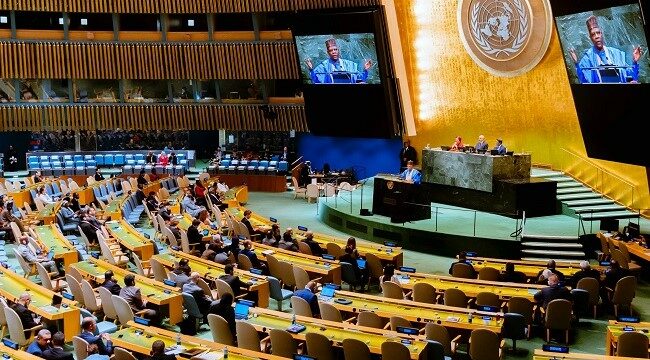
President Bola Tinubu has demanded at least two permanent seats for Africa on the United Nations Security Council, with all the rights and responsibilities of permanent membership, including veto power for as long as it exists.
Tinubu made the demand in his address to the general debate of the 81st session of the United Nations General Assembly (UNGA 81) in New York yesterday, delivered by Vice President Kashim Shettima.
The President said the reform of the United Nations must begin with the reconstitution of the Security Council, arguing that the global institution must reflect the realities of the present world rather than the distribution of power in 1945.
He said, “Africa cannot continue to fill the Council’s agenda while remaining absent from its permanent membership.”
According to him, Nigeria is demanding, in accordance with the Ezulwini Consensus and the Sirte Declaration, at least two permanent seats for Africa, with all the rights and responsibilities of permanent membership, including the veto for as long as it exists, as well as five non-permanent seats in total.
“The authority to speak for humanity carries an obligation to represent it,” he said.
Tinubu also reaffirmed Nigeria’s readiness to assume greater responsibility in global peace and security, citing the country’s contributions to peacekeeping and conflict resolution across Africa.
He noted that Nigeria had committed personnel and resources to peace efforts in Liberia, Sierra Leone, Darfur, Mali and The Gambia.
The President further highlighted Nigeria’s participation in regional initiatives through the Economic Community of West African States (ECOWAS), the African Union and Gulf of Guinea partnerships, including efforts to advance mediation, democratic governance, counterterrorism and maritime security.
Tinubu said Nigeria’s foreign policy was guided by the conviction that national development, continental progress and global peace were interconnected.
He called for reforms to the international financial architecture, wider access to concessional financing and debt sustainability frameworks that recognise the developmental needs of developing countries.
The President also advocated greater support for private capital, blended finance and South-South cooperation to promote sustainable development, climate adaptation and resilient infrastructure.
On climate change, Tinubu rejected what he described as a false choice between development and climate action, saying developing countries must be allowed to industrialise, eradicate poverty and expand energy access through low-carbon pathways.
He reaffirmed Nigeria’s commitment to achieving net-zero emissions by 2060 under the country’s Energy Transition Plan.
The President also called for responsible deployment of artificial intelligence to advance healthcare, education, agriculture, governance and economic productivity.
He said Nigeria was investing in digital public infrastructure, broadband connectivity, innovation ecosystems, research institutions and technology entrepreneurship.
Addressing global security challenges, Tinubu said terrorism, organised crime, cyberattacks and illicit finance continued to exploit gaps between national responses.
He said Nigeria’s prolonged struggle against Boko Haram, ISWAP and other armed groups had demonstrated that military victories must be supported by education, economic opportunities, accountable governance and the protection of communities’ rights and dignity.
The President urged countries to strengthen intelligence sharing, institutional capacity and efforts to disrupt the financing of violence.
On conflicts in Sudan and other war-torn countries, he called for urgent diplomacy, the protection of civilians and compliance with international humanitarian and human rights law.
He said negotiated settlements must respect sovereignty and territorial integrity.
Tinubu reaffirmed Nigeria’s commitment to diplomacy, dialogue and international cooperation, stressing that military victories alone could not secure lasting peace.
He urged the United Nations to strengthen peacekeeping and devote greater attention to peacebuilding, mediation, institution-building and sustainable development.
The President called for a reformed, inclusive and effective United Nations capable of responding to the aspirations of all nations.
He said Nigeria would continue to choose cooperation over confrontation, dialogue over division and partnership over isolation.
We’ve got the edge. Get real-time reports, breaking scoops, and exclusive angles delivered straight to your phone. Don’t settle for stale news. Join THISTIMES on WhatsApp for 24/7 updates →
Join Our WhatsApp Channel