The federal government has launched an emergency intervention in Cross River State following a worsening erosion crisis in Calabar that is now threatening critical national infrastructure, including the Nigerian Navy Ship (NNS) Victory base and a Nigerian National Petroleum Company (NNPC) jetty.
The government described the situation as a major ecological emergency with implications for national security, energy infrastructure and the livelihoods of affected communities.
The intervention will be coordinated by the Ecological Project Office (EPO) in partnership with the Cross River State Ministry of Environment after the collapse of the Channel 2 underground drainage system along Anansa Road triggered severe erosion and flooding in parts of Calabar.
The drainage failure has reportedly caused widespread environmental degradation, damaged infrastructure, disrupted businesses and claimed lives, prompting the federal government to escalate its response beyond what officials described as a routine drainage challenge.
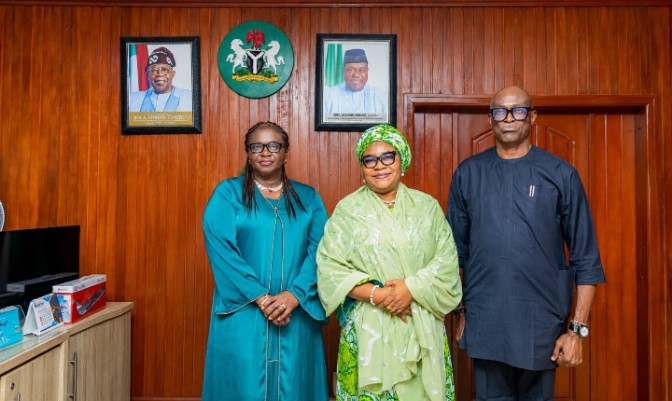
Speaking in Abuja while receiving a delegation from Cross River State led by the Commissioner for Environment, Bassey Offiong Mensah, the Permanent Secretary of the Ecological Project Office, Dr Aishetu Mohammed, said the first phase of the intervention would involve a joint technical assessment of the affected areas.
“The intervention will begin with a joint technical assessment to determine the causes of the crisis and identify sustainable remedial measures. We do not come into a state without partnership with the state and the people,” Mohammed said.
She noted that the assessment would help determine the underlying causes of the drainage collapse and recommend long-term engineering and ecological solutions.
The federal government also said the security dimension of the erosion has necessitated direct engagement with naval authorities because of the potential threat to NNS Victory, a key military installation supporting Nigeria’s maritime operations along the country’s eastern coastline.
Officials added that the National Hydrographic Agency and other technical institutions would participate in evaluating waterway dynamics, erosion patterns and the structural failure of the drainage infrastructure.
Mohammed disclosed that the government is considering the use of advanced analytical technologies, including artificial intelligence, to better understand the ecological processes driving the erosion and support evidence-based intervention.
According to her, the response will go beyond infrastructure repairs to include measures aimed at protecting the livelihoods of residents whose economic activities have been affected by the disaster.
“We do not take culture for granted. We listen to the people and tailor our interventions accordingly,” she said.
She explained that fishermen, youths, traditional institutions and families impacted by the erosion would be considered in the design and implementation of the intervention to ensure sustainable socio-economic recovery.
The Ecological Project Office said the emergency response would combine infrastructural remediation with community-focused recovery efforts as part of a broader strategy to restore affected areas and prevent future ecological disasters.
A date for the joint site assessment by federal and state agencies is currently being finalised.
The erosion in Calabar has increasingly become a matter of national concern as it threatens not only residential communities and public infrastructure but also strategic assets linked to Nigeria’s maritime security and energy operations.
We’ve got the edge. Get real-time reports, breaking scoops, and exclusive angles delivered straight to your phone. Don’t settle for stale news. Join THISTIMES on WhatsApp for 24/7 updates →
Join Our WhatsApp Channel