BY NSE ANTHONY-UKO, BUKOLA ARO-LAMBO, OLUSHOLA BELLO, KINGSLEY OKOH AND DEBORAH BELLO
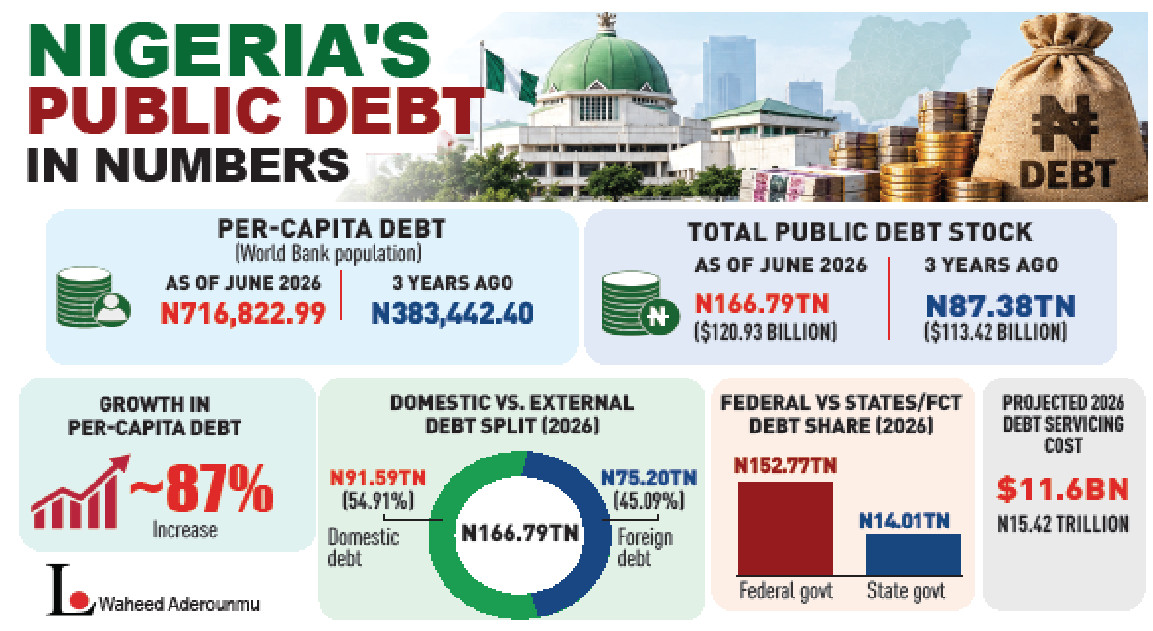
Nigeria’s public debt burden has again sparked public and economic concern after fresh calculations showed that every Nigerian now carries an estimated N716,822 in public debt, up from N383,442 three years ago — an increase of about 87 per cent.
This individual debt figure is based on the latest figures from the Debt Management Office (DMO) divided by the World Bank’s population estimates for both periods.
The rise is even more stark when measured against what Nigerians actually earn, with debt per person now accounting for a far larger share of average income than it did three years ago.
The disclosure has renewed debate about debt sustainability, with economists warning that the pace of borrowing is outstripping the country’s capacity to service its debt. Debt-servicing costs have become a growing concern, with Nigeria projected to spend more than $11.6 billion on debt servicing in 2026 — up sharply from the previous year — even as recurrent government spending continues to rise.
Nigeria’s Debt Stock Grows 90.9% In 3 Years As Borrowing Hits N166.79trn
LEADERSHIP’s checks showed that three years ago, at the end of June 2023 — the first debt figure published after President Bola Tinubu assumed office — Nigeria’s total public debt stock stood at N87.38 trillion.
Divided by the World Bank’s population estimate for that year, 227,882,945, the per-capita debt burden worked out to roughly N383,442 at the time.
Today, with the debt stock at N166.79 trillion as of June 30, 2026, and the population estimated at 232,679,478, per-capita debt has surged to N716,822 — an increase of N333,380 per person, or about 87 per cent, in three years.
The debt stock itself nearly doubled in naira terms, rising by N79.41 trillion, or 90.9 per cent, over the same period.
The per-capita figure shifts depending on the population estimate applied. Using the National Population Commission’s (NPC) own projection of slightly more than 216 million — last updated by NPC Chairman Nasir Isa Kwarra — the current per-capita debt burden rises to roughly N772,175.
Analysts have, however, noted that part of the naira-denominated surge reflects currency depreciation rather than new borrowing alone.
Recall that in June 2023, shortly after the naira was floated under the new administration, the official exchange rate closed the month at N769.25/$1 at the I&E window. By comparison, the official NFEM rate as of September 2026 stood at about N1,329/$1 — a depreciation of about 72.8 per cent over the three-year period.
That currency slide means Nigeria’s dollar-denominated debt grew far more moderately than the naira figures suggest: from about $113.6 billion in June 2023 to $120.93 billion in June 2026, an increase of only about 6.4 per cent.
Debt Burden Outpacing Income
A more troubling picture emerges when per-capita debt is weighed against per-capita income.
According to World Bank data, Nigeria’s GDP per capita stood at roughly $1,596.6 in 2023. At the June 2023 exchange rate of N769.25/$1, this translated to approximately N1,228,378 per person. That put per-capita public debt of N383,442 at about 31 per cent of per-capita income at the time.
By 2024 — the most recent year for which World Bank figures are available — Nigeria’s GDP per capita had fallen to $806.9, a drop of more than 49 per cent, driven largely by the naira’s devaluation and the rebasing of the economy. Converted at the current exchange rate of roughly N1,329/$1, that amounts to approximately N1,072,368 per person in naira terms.
Against this lower income base, per-capita debt of N716,822 now represents nearly 67 per cent of per-capita income — more than double the debt-to-income share recorded three years ago.
The decline in dollar-denominated income has been dramatic by regional standards. Nigeria’s GDP per capita, which remained above the Sub-Saharan Africa average from 2002 to 2023, fell to $806.9 in 2024 — about $710 below the regional average of $1,516.4, the widest gap in more than two decades.
Economists say this combination — a debt burden rising even as the income base against which it must be repaid shrinks — is a central reason why the per-capita debt figures have alarmed analysts more than the naira totals alone might suggest.
The Current Numbers
The DMO’s most recent data puts total public debt at N166.79 trillion as of June 30, 2026, up from N159.35 trillion recorded at the end of March 2026, representing a 4.7 per cent quarter-on-quarter increase.
A breakdown shows that domestic debt accounted for N91.59 trillion, or 54.91 per cent of the total, while external debt stood at about N75.20 trillion, or 45.09 per cent.
The federal government accounted for N152.77 trillion of the total, comprising N86.99 trillion in domestic debt and N65.77 trillion in external obligations, while the states and the FCT jointly held N14.01 trillion.
The disclosure has drawn sharp reactions from civil society, economists, business leaders and ordinary Nigerians, many of whom questioned whether the country’s rising debt has translated into tangible benefits for citizens.
Commenting on the development, the executive director of the Civil Society Legislative Advocacy Centre (CISLAC) and Head of Transparency International (TI) Nigeria, Auwal Ibrahim Musa Rafsanjani, raised concerns over the country’s rising debt profile.
Describing it as “a major concern”, he said: “CISLAC is really particularly concerned about the growing pressure that debt servicing can place on public finances.
“Borrowing can be a legitimate instrument of development when it finances productive infrastructure, human capital, industrial development, and investments capable of generating economic returns.
“But the kind of borrowing and debts we have have nothing to do with what I have just mentioned. It is more of an opportunity to divert and still waste public taxpayers’ money. For us, accumulating debts while citizens continue to experience inadequate healthcare, deteriorating public education, poor electricity supply, unemployment, poverty, insecurity and infrastructure deficits are actually serious issues.
“It means that the question of value for money, fiscal discipline and accountability is completely absent from what we are seeing today in Nigeria.
“Nigeria cannot continue borrowing and transferring repayment obligations to future generations without demonstrating clearly where the money went. We want to know what projects were financed, who executed those projects, what results were achieved, and how these investments will generate economic or social returns.”
On his part, the national president of the Association of Small Business Owners of Nigeria (ASBON), Dr Femi Egbesola, said the rise in Nigeria’s estimated debt burden per citizen from N383,442 to N716,822 was concerning, but clarified that this did not mean every Nigerian personally owed that amount.
He explained that the figure was simply the country’s total public debt divided by its population.
“Debt itself is not necessarily bad if it is used to finance productive investments that expand the economy, create jobs and increase government revenue,” he added.
He explained that the real concern was whether the country was borrowing to create value or simply borrowing to meet recurrent obligations while the cost of servicing the debt continued to rise.
“For businesses and MSMEs, the key question is whether these borrowings are translating into better infrastructure, reliable power, lower production costs and easier access to finance. For me, this is not so at the moment.
“Nigeria must move from simply measuring how much we owe to asking what we are achieving with what we borrow.”
Also, the founder of DAL Concept Strategy, Pelumi Oladeji, said the rising debt could further limit the government’s ability to fund critical areas of the economy if the trend was not properly managed.
“A growing share of government revenue will continue to be spent on debt servicing instead of critical sectors such as education, healthcare, infrastructure and security,” he said, warning of reduced fiscal flexibility and slower national development.
Oladeji said the way forward would depend on the government’s ability to grow revenue faster than it takes on new debt.
This, he said, would require “stronger economic productivity, improved revenue generation, export growth, and greater discipline in public spending,” adding that reducing the debt burden should be viewed as “a medium- to long-term objective rather than an immediate expectation.”
A statistician, Oluwatimileyin Onasanya, however argued that the rise in Nigeria’s debt burden should not necessarily be viewed as a problem, stating that borrowing could help a developing country finance important projects.
“The main issue is not borrowing but actually failing to use the borrowed money for its intended use,” he said.
According to him, borrowing should create opportunities through investments in infrastructure and other projects, but this has not happened because of how the funds are allocated.
Onasanya added that Nigeria should not stop borrowing but must ensure that borrowed funds are properly channelled towards development.
“A country cannot develop on its own resources,” he said, adding that the focus should be on improving the debt-to-GDP ratio and ensuring that borrowing contributes to economic growth.
He also said the rising debt was not directly responsible for the cost-of-living crisis, pointing instead to “the cost of dollars vs the naira” and the imbalance between imports and exports.
In his own reaction, Mr Eyitayo Oladapo said he did not see any clear benefit Nigerians were getting from the rising debt.
“We don’t believe what they are telling us they use the money to produce,” he said, adding that “the rich are getting richer and the poor are not getting out of it.”
He also expressed concern about continued borrowing, saying the country could not afford to keep accumulating debt at the current rate.
“They are borrowing money and they are saying that we are the ones that will pay it. I don’t understand,” he said, noting that the rising debt was coming at a time when Nigerians were already struggling with high living costs.
The vice chairman of Highcap Securities Limited, David Adonri, said the rise was worrisome because borrowing had not translated into improved living standards.
“If debt per citizen has moved from N383,000 to over N716,000 in three years, we should be seeing corresponding improvement in infrastructure, power and productivity. Instead, cost of living is rising and purchasing power is declining,” he said.
Adonri warned that continued borrowing without efficient utilisation could crowd out private-sector investment and put pressure on future budgets through debt-servicing obligations.
The Managing Director of Globalview Capital Limited, Mr Aruna Kebira, said borrowing was not bad in itself if the funds were channelled into productive purposes and the return on investment outweighed the cost of funds.
Kebira said the government borrows to finance budget deficits when it needs to spend beyond what it generates within a fiscal year.
“When you are borrowing, you make sure that what you are putting the money into is justified. If it is for business, you ensure the return on investment is higher than the cost of funds. Assuming it is used judiciously and channelled into the projects for which it was borrowed, there is no problem,” he added.
He, however, expressed concern that in developing countries, especially in Africa, borrowed funds often do not match the purposes for which they were borrowed.
“What has characterised Africa is that this fund will end up in private pockets. Then the debt becomes government’s own while the fund becomes private,” he said.
Kebira noted that while the United States is the highest debtor globally, it has the advantage of owing in its own currency, which it can print to repay. In contrast, Nigeria has to source dollars or use oil revenues to repay dollar-denominated debts.
He warned that rising debt was a bad signal because debt servicing is included in the following year’s budget, potentially forcing the government into a cycle of deficits.
He advised the government to reduce borrowing and focus on critical infrastructure, adding that even borrowed funds are often inflated, poorly executed or abandoned.
We’ve got the edge. Get real-time reports, breaking scoops, and exclusive angles delivered straight to your phone. Don’t settle for stale news. Join THISTIMES on WhatsApp for 24/7 updates →
Join Our WhatsApp Channel