The Masaki programme is an initiative by the Jigawa State Government aimed at tackling child malnutrition and stunting rates by using locally available food items within communities.
The Masaki programme was launched in 2018 and has already begun to yield fruitful results, attracting other states to adopt the model and donor partners such as UNICEF to take part in the project.
For years, Jigawa State has been tagged among the states with high rates of child malnutrition and stunting, with much emphasis being paid to curative aspects.
If left untreated, malnutrition leads to stunting, negatively affecting a child’s growth, mental development, and overall health, often resulting in permanent disability or premature death.
In Jigawa State, as in other regions, two major approaches have been employed to combat child malnutrition and stunting: “Specific” and “Sensitive” interventions.
The “Specific” approach involves admitting severely malnourished children to hospitals or providing them with Ready-to-Use Therapeutic Food (RUTF).
For over a decade, UNICEF was the primary supplier of RUTF, distributed across more than 25 Community Management of Acute Malnutrition (CMAM) centres in the state.
Initially, RUTF was imported, but in recent years, Dangote Foods Company began local production in Nigeria. This development has eased procurement challenges, improved availability, and widened coverage.
The “Sensitive” approach educates nursing mothers and women of childbearing age on how to prepare balanced diets tailored to their age. This is known as the Infant and Young Child Feeding (IYCF) programme.
Jigawa State has domesticated and expanded this initiative under the “Masaki” programme.
The Masaki programme has proven effective in preventing child malnutrition and stunting, with women of childbearing age across all 27 local government areas receiving training.
The Masaki programme, which can be simplified as an Infant, Young Child, and Pregnant Women Nutrition project, is intended to promote the production and use of an appropriate, balanced diet across different stages of child growth.
Under the Masaki programme, nutrition specialists and other community health workers visit designated health facilities and community centres, particularly in rural areas, for food demonstrations.
At the food demonstration centres, pregnant women, lactating mothers, and teenage girls are taught how to use locally available foods to prepare a balanced diet for children from ages 6 to 5 years, as well as the types of food needed for pregnant women and lactating mothers.
In each of the 27 local government areas, the programme is being implemented with support from the local government council, which provides transport allowances for the health workers and community members who provide the food items for the demonstration.
The programme started with the 1.0 formula and has now moved to the 2.0 formula. Its impact in preventing child malnutrition has shown very good results, with community resilience, adaptability, and sustainability.
This initiative has contributed to a decline in malnutrition rates—from 64% in 2018 to 55.5% in 2024, according to the National Demographic and Health Survey (NDHS).
To further strengthen the fight against malnutrition by using locally available resources, Governor Malam Umar Namadi approved the training of 600 women in producing “Tom Brown”, a locally sourced nutritional formula that serves as an effective alternative for preventing and treating moderately malnourished children.
Tom Brown—composed from natural ingredients—has no adverse effects and can also serve as a complementary food to enhance children’s nutrition
This approach is sustainable, as all components are readily available in local markets, enabling mass production and reducing reliance on RUTF.
While Tom Brown cannot fully replace RUTF, it can reduce dependence by over 70%, preventing many children from progressing to severe acute malnutrition.
As the Masaki programme recorded significant success and demonstrated its affordability and sustainability in tackling malnutrition and enhancing child growth and survival, UNICEF took an interest and selected three local governments for its pilot intervention.
Under its intervention, UNICEF provides more technical and logistical support to improve the Masaki programme, with an additional mechanism to build the capacity of communities and families to take full control.
At the community level, UNICEF supports families, particularly in rural areas, by providing seeds and helping them obtain food from backyard gardening, where vegetables and crops can be planted for family use.
At the village level, families who benefited from the backyard gardening intervention revealed how the programme impacted their children’s lives.
Not only do they have more food for their children, but they also gain a better understanding of the importance of child vaccinations and hospital antenatal and postnatal care.
According to Ramatu, one of the beneficiaries in Sintilmawa Ward, “the intervention has opened our eyes beyond nutrition. It also gives us a better understanding of how we seek healthcare services during pregnancy, visit facilities for delivery, and take our children to the hospital for routine immunisations. Thanks to the Jigawa State Government. Thanks to UNICEF for their humanitarian concern.”
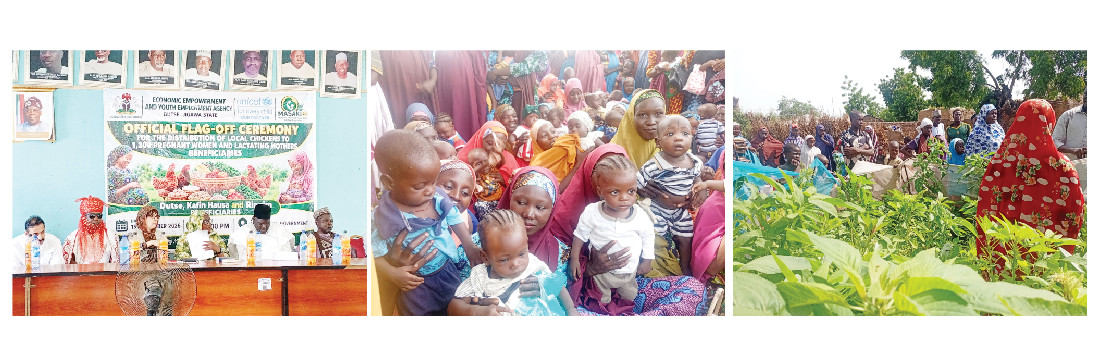
Besides backyard gardening, UNICEF also introduced chicken empowerment, under which low-income families are supported with four local chickens that can help them get eggs for their children and also serve as a simple source of income.
During her tour visit to Jigawa to inspect some of the programmes implemented by UNICEF, she flagged off the distribution of 1,200 chickens to 400 pregnant and lactating mothers in Ringim Local Government.
She expressed her satisfaction with the commitment of the state, local governments, communities, families, and other stakeholders in fighting against child malnutrition.
The success of the Masaki programme demonstrates how collective ideas, initiatives, and practical determination can tackle any challenges in the community, no matter how old or deep-rooted they are in society.
“I hope this provision of chickens will help in strengthening the food basket of the beneficiaries’ families and also become another model to reflect on in all the 27 local government areas of the state and beyond.”
During her stay in Jigawa State, Mrs Judith Leveillee, Chief of Field Operations and Emergency at UNICEF, led the official flag-off of the Accelerated Basic Education Programme (ABEP), aimed at providing learning opportunities for out-of-school children and adolescents in the state.
The programme, funded under the European Union’s Education and Youth Empowerment Programme in Northern Nigeria (EYEPINN), is being implemented through 135 learning centres across ten Local Government Areas of Jigawa State.
The intervention is designed to provide a second chance to children who have either never attended school or whose education has been interrupted, enabling them to acquire foundational literacy and numeracy skills and subsequently progress to formal education, vocational training, or other appropriate learning pathways.
80,000 out-of-school children and teenagers are targeted for the project, with 270 facilitators engaged across 10 LGAs.
The initiative represents an important step in the collective effort to ensure that every child, regardless of gender or circumstance, has access to safe, inclusive, and relevant education.
All the key areas in which UNICEF provides interventions are 100% in tandem with Governor Malam Umar Namadi’s 12-point agenda, which emphasises access to education, food security, and opportunities to grow and compete for every child in the state.
The Jigawa State Government has always been grateful to UNICEF, as emphasised by Governor Namadi, who described it as a reliable partner that has supported Jigawa State since its creation 36 years ago, particularly in the nutrition sector.
We’ve got the edge. Get real-time reports, breaking scoops, and exclusive angles delivered straight to your phone. Don’t settle for stale news. Join THISTIMES on WhatsApp for 24/7 updates →
Join Our WhatsApp Channel