As artificial intelligence reshapes economies, industries and global power relations, the race for technological dominance is intensifying among world powers, with countries investing heavily in AI research, innovation and infrastructure. For Nigeria, the global AI revolution presents both challenges and opportunities, raising questions about its readiness, capacity to compete and potential to harness the technology for economic growth, job creation and national development. OLAMIDE OJUOKAIYE reports
Artificial intelligence (AI) is rapidly moving from experimental technology to a major force shaping businesses, jobs, national economies and global security, with the emergence of so-called agentic AI enabling systems to perform tasks, manage workflows and make decisions with less human intervention.
Beyond its impact on existing businesses, AI is also lowering barriers to entrepreneurship. Meta Chief AI Officer Alexander Wang recently highlighted how small businesses are using AI-powered WhatsApp agents, which can be created within minutes, alongside generative AI tools for advertising and customer engagement. Meta has also extended its agentic AI push to small businesses through its Muse platform, which connects AI agents to business applications and automates parts of daily operations.
The economic impact is also evident in new business creation in the United States. Torsten Slok, chief economist at Apollo Global Management, has highlighted a strong link between AI adoption and business formation, with sectors recording higher AI adoption also seeing stronger growth in new business applications. His analysis, based on US Census Bureau data, suggests that AI and large language models are reducing some of the cost and complexity of starting a business.
For entrepreneurs, this means that activities that previously required large teams, including research, content creation, customer engagement, software development and parts of professional services, can increasingly be supported by AI tools.
But the rapid expansion of AI has also intensified concerns about its potential consequences. The debate has increasingly focused on job disruption, cybersecurity, misuse of powerful systems, autonomous decision-making, and the difficulty of ensuring that increasingly capable models operate within intended boundaries.
Microsoft co-founder Bill Gates, once among the technology sector’s more optimistic voices on AI, has warned of the disruptive consequences of increasingly powerful systems, including risks to employment and the possibility that malicious actors could exploit advanced technologies.
The debate has also reached the highest levels of the technology industry and of global politics. OpenAI and other AI companies have called for stronger safeguards for increasingly capable systems, while other technology leaders have placed greater emphasis on innovation, competition and the need to avoid slowing technological development.
In the United States, President Donald Trump has continued to emphasise the need to maintain American leadership in advanced AI technology. On September 29, 2026, he signed an executive order titled “Inaugurating the Era of Super Intelligence,” directing the executive branch to use the term “Super Intelligence” instead of “Artificial Intelligence” in official communications and calling for further work on a federal definition of the technology.
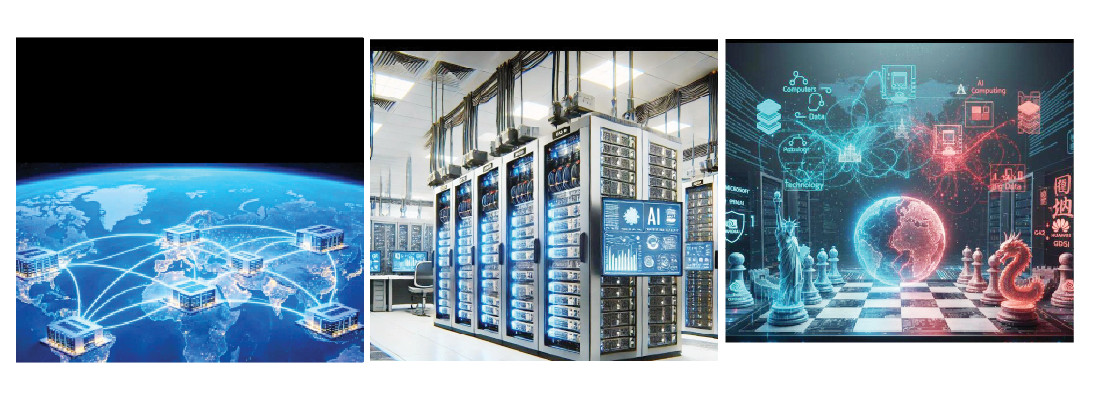
The developments illustrate the intensity of the global technology race, particularly as the United States seeks to maintain its position at the forefront of advanced computing and AI, while China and other technology powers continue to expand their capabilities.
For Africa, however, the debate is about more than which country develops the most powerful AI model.
AI could accelerate development across the continent, but it could also deepen existing technological and economic gaps. Africa’s challenge is therefore not simply to adopt AI applications developed in Silicon Valley, Europe or Asia, but to build the infrastructure, data, computing capacity, skills, research institutions and businesses needed to participate meaningfully in the emerging AI economy.
The African Union has recognised AI as a strategic priority. Its Continental Artificial Intelligence Strategy calls for an Africa-centred approach built on infrastructure, talent, datasets, computing capacity, research, innovation, investment and appropriate governance. The strategy also emphasises the need for AI systems to reflect Africa’s languages, cultures and development realities.
The challenge, therefore, extends far beyond software.
AI requires reliable electricity, data centres, broadband networks, cloud infrastructure, computing capacity, research institutions and skilled workers. Without these foundations, African countries risk remaining largely consumers of systems developed elsewhere, while a significant share of the economic value generated by African data and markets accrues outside the continent.
The African Union has also identified gaps in digital infrastructure, AI skills, high-quality datasets and funding as major constraints to the continent’s ability to scale AI.
Nigeria has begun putting several pieces of that foundation in place.
The Federal Ministry of Communications, Innovation and Digital Economy has developed initiatives, including the National Artificial Intelligence Strategy, the Nigeria Artificial Intelligence Research Scheme, Project BRIDGE and the 3 Million Technical Talent (3MTT) programme.
Project BRIDGE targets at least 90,000 kilometres of fibre-optic infrastructure, while 3MTT is designed to strengthen Nigeria’s technical talent base across areas such as artificial intelligence, machine learning, data science, cloud computing, software development, and cybersecurity.
The 3MTT programme could become an important part of Nigeria’s response to the AI transition, as the emerging contest is increasingly about people who can build, deploy, manage and commercialise AI systems, rather than simply use them.
The first phase involved 30,000 fellows, while the second phase is designed to train an additional 270,000 technical talents. NITDA, which is collaborating on the programme, has also been pursuing broader digital capacity building, and its AI Transformation Roadmap includes the use of generative and agentic AI in the agency’s operations.
Nigeria is also seeking to develop locally relevant AI systems through N-ATLAS, an open-source, multilingual large language model supporting Yoruba, Hausa, Igbo, and Nigerian-accented English.
The Federal government, through NCAIR and the Office for Nigerian Digital Innovation, launched the National AI Innovation Challenge in September to encourage developers, universities, startups, and technology companies to build practical applications using the model across sectors such as healthcare, agriculture, education, legal services, and financial inclusion.
These initiatives signal an important shift in Nigeria’s AI conversation: from merely adopting foreign technology to developing systems that can respond to Nigerian languages, markets and economic challenges.
The bigger question, however, is whether these initiatives can translate into businesses, jobs, productivity and productive applications at scale.
AI may make it easier for an individual to establish a company with a small team, as Slok’s analysis suggests, but the same technology could also automate routine tasks and increase pressure on workers whose roles are highly exposed to automation.
The economic opportunity will therefore depend increasingly on whether Nigerians can acquire the skills to use and supervise AI, develop applications around it, and, most importantly, build businesses that own and commercialise the resulting intellectual property.
For Nigeria, this creates a race across several fronts.
The country needs more technical talent, but it also needs entrepreneurs capable of turning technical capabilities into commercially viable businesses. It needs data, but also institutions capable of governing and using it productively. It needs digital infrastructure, as well as affordable access to the computing power required to train and deploy increasingly sophisticated AI systems.
Ultimately, the AI revolution is becoming a contest not only over who builds the most powerful models but also over who controls the infrastructure, data, talent, computing capacity and intellectual property underpinning them.
Africa has an opportunity to avoid repeating earlier technology cycles, in which it remained largely a consumer of systems developed elsewhere. The African Union has already recognised the need for home-grown capacity, investment, talent and infrastructure as part of the continent’s AI strategy.
Nigeria has begun assembling some of the building blocks through its AI strategy, 3MTT, N-ATLAS, digital infrastructure, and research initiatives.
The challenge now is to integrate those efforts into an economy in which Nigerians are not merely users of other people’s AI, but developers, entrepreneurs and owners of technologies capable of solving local problems and competing in global markets.
That may ultimately determine Nigeria’s position in the global AI revolution.
We’ve got the edge. Get real-time reports, breaking scoops, and exclusive angles delivered straight to your phone. Don’t settle for stale news. Join THISTIMES on WhatsApp for 24/7 updates →
Join Our WhatsApp Channel