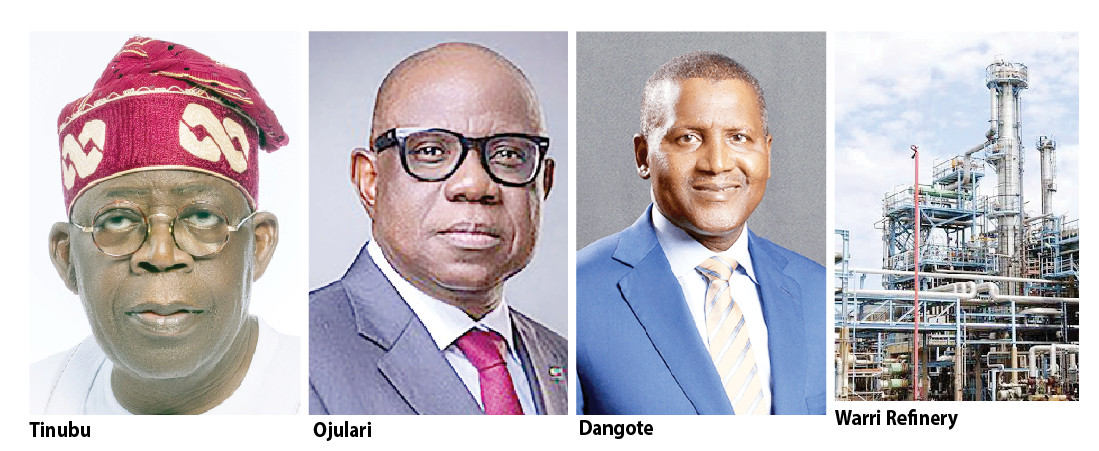
Sixty-six years after independence, crude oil still supplies the dollars that keep Nigeria’s economy running, but it has not delivered the broad-based prosperity many Nigerians expected. Rising production, lower reported theft, and the rise of the Dangote Refinery point to a recovery, yet pollution, oil theft, weak diversification, and unfinished reforms show that the country’s oil wealth remains both a blessing and a burden, writes NSE ANTHONY-UKO.
When Nigeria became independent in 1960, commercial oil production was still in its infancy. Production at Oloibiri in the Niger Delta began in 1958 at about 5,140 barrels per day, but by 1966 output had risen above 417,000 barrels per day, according to a Central Bank of Nigeria review.
That rapid expansion shifted the country’s economic direction. Nigeria moved from an economy largely based on agriculture and other commodity exports to one increasingly financed by crude oil. By the 1970s, oil had become the dominant source of government revenue and foreign exchange, while agriculture’s contribution to export earnings had weakened sharply.
The National Bureau of Statistics said oil accounted for less than one per cent of Nigeria’s export value in 1958 but rose to as much as 97 per cent in 1984. Its share of exports has remained above 90 per cent for much of the period since then.
The scale of the transformation explains why oil has remained central to Nigeria’s politics, public finances and foreign policy. It funded roads, airports, public buildings and government programmes. It also financed a large share of the country’s imports and helped successive governments maintain access to foreign exchange.
But many analysts agree that oil has not delivered the broad-based prosperity many Nigerians expected, as it has weakened incentives to develop agriculture and manufacturing, encouraged rent-seeking, and left public finances exposed to fluctuations in oil prices, production disruptions, and foreign demand.
Sixty-six years after independence, crude still shapes the daily lives of people who may never see an oil field: the trader who pays for transport, the family that cooks with what it can afford, and the fishing community whose waters carry crude.
The question, therefore, is not merely how much oil Nigeria has produced. It is what the country has built with the proceeds, who has benefited, who has paid the environmental and social costs, and whether enough has been done to prepare for a future in which oil may no longer command the same value.
Oil has been a blessing in the revenue it generated, a curse in the pollution and dependence it entrenched, and a missed opportunity in the development it failed to deliver at scale.
What Oil Gave — And Took
Crude oil remains Nigeria’s most valuable single export. National Bureau of Statistics data showed that Nigeria earned N12.91 trillion from crude oil exports in the second quarter of 2026, representing 47.79 per cent of total exports. Petroleum-related products accounted for about 86 per cent of the country’s total export basket.
The figures underline the continuing importance of oil to Nigeria’s external finances. When production falls, or international prices weaken, the effects are felt through the naira, imported goods, transport costs and household budgets.
Yet there was also a potentially significant change in the composition of exports. Non-crude exports, including refined petroleum products, natural gas and urea, overtook crude exports in the second quarter of 2026.
Analysts said the development showed that Nigeria’s export base was beginning to change, although they cautioned that much of the improvement remained tied to the oil and gas value chain.
That distinction matters. Nigeria may be shifting from exporting crude to exporting refined products and other energy-related commodities, but it has not yet built a sufficiently broad export economy based on manufacturing, agriculture, and services.
Commenting on the country’s continued exposure, economist Festus Tokunbo warned that Nigeria could lose some of its largest oil buyers within a decade as China and India accelerate their shift towards renewable energy and gas. He said the country should use the current period of strong oil demand to expand agriculture, manufacturing, services and renewable energy.
Tokunbo’s warning captures Nigeria’s central dilemma: oil is less dominant in the wider economy than it once was, but the country still depends heavily on crude for the foreign exchange needed to stabilise the naira and pay for imports.
Production Recovery, But Below Target
Nigeria’s production performance has improved in 2026, although it remains below the government’s budgetary assumption.
The federal government’s 2026 budget was based on production of 1.84 million barrels per day and an oil price of $64.85 per barrel. However, average output in the first half of the year was about 1.6 million barrels per day, according to the State House.
Yet available data show that Nigeria’s July output was still below the budget assumption and the government’s target of raising production to 2.4–2.5 million barrels per day under its production-recovery programme.
The shortfall has a direct fiscal cost. In June, analysts estimated that Nigeria lost $839.22 million in oil revenue in the first four months of 2026 for failing to meet its OPEC production quota.
There has, nevertheless, been a marked recovery. The Nigerian Upstream Petroleum Regulatory Commission reported that Nigeria produced 1,677,777 barrels of crude and condensate per day in August, a 0.4 per cent increase on July. The country met its OPEC quota for the fourth consecutive month.
June was the strongest month of the recent recovery. The NUPRC reported that crude production, excluding condensates, reached 1.56 million barrels per day, the highest level in more than six years. Including condensates, total production rose to 1.735 million barrels per day. The regulator attributed the improvement to more stable operations and improved pipeline reliability.
NNPC Group Chief Executive Officer Bayo Ojulari provided a recent update, stating that crude and condensate output had reached a five-year peak of 1.77 million barrels per day, while gas supply rose to a three-year high of 7.2 billion standard cubic feet per day. He reiterated NNPC’s targets of two million barrels per day by 2027 and three million barrels per day by 2030, as well as gas targets of 10 billion cubic feet per day by 2027 and 12 billion cubic feet per day by 2030.
Analysts said the improvement was encouraging but insufficient. Higher prices and production should normally generate a windfall, but Nigeria cannot fully benefit from favourable market conditions if it continues to produce below budget assumptions. They described the current opportunity as an oil windfall with “an expiry date”, warning that higher prices and improving production would provide only temporary relief unless Nigeria used the earnings to address its structural weaknesses.
Nigeria’s problem is not only the price of crude. It is also the failure to produce consistently enough to convert favourable prices into predictable public revenue.
The Niger Delta: The People Who Carried The Weight
The heaviest burden of oil production has always fallen on the communities where crude is extracted. Spills have damaged farmland and creeks that families rely on for food and income, while gas flaring and poorly maintained facilities have deepened distrust among communities, companies and government.
The Ogoni protests of the 1990s, the execution of Ken Saro-Wiwa, militancy in the 2000s and the 2009 amnesty all reflected a single grievance: communities saw petroleum wealth leave their land while poverty, pollution and unemployment persisted. The Ogoniland cleanup recommended after the 2011 UNEP report has made progress, but it remains unfinished. HYPREP says it has closed 30 of the 65 UNEP-identified sites, while 17 medium-risk sites are still being remediated, and investigations continue at 18 high-risk locations. It also reports progress in shoreline cleanup, mangrove restoration, water access and women’s participation, with former artisanal refiners now being engaged to prevent renewed pollution.
The development is important because it treats residents as partners in environmental protection rather than merely as security risks. Yet completion figures alone do not prove that communities have regained their farmland, fishing waters, health or income. Ogoniland remains caught between the push to resume oil production, the unfinished cleanup and the need to rebuild community trust.
The wider lesson is that environmental repair in the Niger Delta is a long-term governance task that requires independent testing, community participation and a credible plan to prevent new pollution.
Oil Theft: Lost Barrels, Lost Livelihoods
Oil theft remains one of the clearest examples of how petroleum wealth can be lost before it reaches the Federation Account or benefits producing communities.
NEITI estimated that Nigeria lost N16.25 trillion between 2009 and 2020 to crude oil theft and sabotage, amounting to more than 619.7 million barrels. In 2022 alone, the country lost 36.69 million barrels, the agency noted in its reports.
Illegal tapping and artisanal refining also cause spills, damage wetlands, and expose residents to hazardous pollutants.
There has been a significant improvement in recent years. Industry reports said oil theft fell by 79 per cent, with the reduction attributed to stronger surveillance, security operations, and pipeline protection work by Tantita Security Services.
The decline in theft has coincided with the recovery in crude production and with Nigeria’s return to compliance with its OPEC quota.
But the improvement should not be taken as proof that the problem has ended. Stakeholders in the Niger Delta have urged the government to distribute pipeline-security contracts more widely across states and host communities.
The issue is therefore not only whether pipelines are protected. It is also who receives the contracts, who gets the jobs and whether the people living around the facilities are treated as partners in protecting them.
A security arrangement that raises output but excludes communities could temporarily reduce theft without resolving the grievances that produce conflict.
Refineries And The Dangote Effect
For decades, Nigerians queued for petrol in a country that produced crude oil by the millions of barrels. The state-owned refineries in Port Harcourt, Warri and Kaduna underwent repeated rehabilitation spending but failed to deliver a steady domestic output.
NNPC Group Chief Executive Officer Bayo Ojulari said the company would no longer pursue refinery rehabilitation without a viable commercial model. “We will not go ahead with the refinery if we cannot see a path to profitability,” he said, adding that NNPC would seek technical equity partners with a stake in performance.
That position marks a shift in the state-refinery debate. The issue is no longer simply whether more public money should be spent on rehabilitation, but whether the plants can operate sustainably and attract partners willing to share commercial risk.
The emergence of Dangote Refinery has changed the downstream market.
NMDPRA data showed that crude receipts at Nigerian domestic refineries rose by 17 per cent in August 2026, from 585,000 barrels per day in July to 683,000 barrels per day. Dangote Refinery recorded an average capacity utilisation of 105.21 per cent during the month.
The refinery’s growing output has reduced reliance on imports. NMDPRA data showed that the refinery’s petrol stock reached 630.9 million litres in August, while daily petrol imports fell by 26 per cent.
Nigeria also earned about $750 million from petrol exports in the first half of 2026, six times as much as in the comparable period, according to analysts. Investment research analyst Abeeblahi Rufai attributed the increase in part to the Dangote Refinery moving beyond its initial ramp-up problems.
Rufai also identified the main constraint facing the refinery: crude supply. Dangote Refinery has a processing capacity of 700,000 barrels per day and is expected to expand further, but feeding the plant will require Nigeria’s upstream production to rise.
The refinery became the focus of Africa’s largest initial public offering when Dangote Group opened an offer for 4.1 billion shares on 14 September. The company sought to raise N2.15 trillion, or about $1.6 billion, with the amount potentially rising to about $2.1 billion if the offer was oversubscribed and the greenshoe option was exercised.
Speaking to the link between production and domestic value addition, the Minister of State for Petroleum Resources (Oil), Heineken Lokpobiri, said that increased crude output alone would not transform the economy unless it was supported by refining, transport, storage and a competitive market.
“Increased production must be matched by adequate infrastructure, efficient transportation and storage systems, expanded refining capacity, and a competitive market that delivers value to consumers and investors,” Lokpobiri said on Wednesday.
The development has strengthened Nigeria’s refining prospects, but it has also created a regulatory challenge, with analysts warning that Nigeria’s refining revolution could lead to a monopoly.
Although Dangote has reduced fuel imports, concentrating supply at a single major refinery could leave consumers exposed to disruptions or weakened competition.
On the regulatory challenge, NMDPRA Authority Chief Executive Rabiu Abdullahi Umar said that compliance alone was insufficient. “Compliance, while essential, is not an end in itself,” he said. “The broader objective is to create a petroleum industry characterised by certainty, predictability, transparency and confidence.”
Umar also argued that Africa’s refining capacity should reduce the influence of offshore crises on regional fuel prices. He said it was unreasonable for crises in Western Europe and the Mediterranean to determine fuel prices in Africa, given the continent’s refining capacity, which could support a more transparent regional market.
The conclusion is not that Dangote Refinery is a problem. Rather, its success makes effective regulation more important. A refinery can solve the import problem while creating new questions about market concentration, pricing and consumer protection.
Domestic Crude Supply: Regulation Versus Commercial Reality
The Petroleum Industry Act requires domestic crude oil to be supplied to local refineries. However, NUPRC’s figures show the difference between crude allocated, crude offered, and crude actually delivered.
In May, NUPRC said 61.9 million barrels had been allocated to domestic refineries during the first quarter of 2026, while producers collectively offered 68.7 million barrels.
Actual deliveries were significantly lower, reflecting disputes over pricing, crude quality, commercial terms and logistics.
The second-quarter figures were stronger. NUPRC said 53.7 million barrels were supplied to local refiners between April and June, representing 97.4 per cent of the domestic crude supply obligation. Producers offered Dangote Refinery 68.1 million barrels against its requirement of 63 million barrels, but the refinery accepted 52.6 million barrels.
The commission later reported that producers offered 182 million barrels to domestic refiners between January and August 2026, while 112 million barrels — or 61.4 per cent — had been transacted.
NUPRC Chief Executive Oritsemeyiwa Eyesan said the domestic-refining drive could not succeed by merely redistributing inadequate output among competing refiners. “Domestic refining cannot thrive by distributing a shrinking cake,” Eyesan said.
Analysts said domestic refineries could require up to 1.5 million barrels per day of crude, while producers argued that government policy should increase overall national production rather than redistribute a declining volume among competing users.
This is the central tension in Nigeria’s domestic refining strategy. Allocating crude to local refineries may reduce imports, but if total production does not increase, refiners, exporters and government revenue will compete for the same limited barrels.
On the dispute over domestic crude supply, Ojulari said NNPC would continue to honour the Federal Government’s naira-for-crude arrangement for the Dangote Refinery while supplying additional available volumes in dollars.
The regulator should therefore publish regular data on crude allocations, offers, accepted volumes, actual deliveries, grades, prices, and the reasons for undelivered cargoes.
Such information would enable the public to distinguish between producer non-compliance, refinery constraints and commercial disagreements.
NNPC And The Subsidy Debate
NNPC Limited was established under the Petroleum Industry Act as a commercial company, with expectations of greater transparency, financial discipline and accountability.
Nigerians will ultimately judge the company by practical results: a reliable fuel supply, transparent accounts, stronger production, and revenue that reaches the Federation.
The petrol subsidy was one of the few ways many citizens felt they shared directly in the country’s oil wealth. But it was also costly, poorly targeted, and vulnerable to fraud and arbitrage. Its removal in May 2023 pushed up transport and food prices and shifted the market towards higher, more volatile petrol prices.
The federal government continues to defend the decision. The State House said that removing subsidies and other fiscal reforms had increased revenues available to states and local governments, giving them more room to fund roads, schools, hospitals, salaries, pensions and social programmes.
The government has also argued that removing subsidies was necessary to make large-scale private refining commercially viable. It said the Dangote Refinery could not have operated successfully under the former subsidy regime because regulated prices would have made investment difficult.
Lokpobiri defended the deregulated pricing regime, saying the Federal Government could not arbitrarily reduce petrol prices without effectively reinstating the subsidy.
“The Bola Tinubu government has no power to reduce or increase petrol prices. It is fully deregulated in line with global best standards,” he said. “Crude oil and refined products are a global business. Nigeria doesn’t exist in isolation. You cannot arbitrarily reduce prices unless you want to revert to a subsidy,” he added.
Critics say the policy should not be judged only by its ability to attract private investment. Human rights lawyer and Senior Advocate of Nigeria Femi Falana called for greater crude oil allocation to local refineries and demanded stronger accountability for the benefits of higher oil revenue.
Former labour leader Mustapha Wali proposed a petroleum price moderation and stabilisation reserve to cushion consumers against international oil-price shocks. He also called for independent technical and commercial assessments of the state-owned refineries to determine whether they could still be economically viable to rehabilitate.
The debate has therefore moved beyond whether the removal of subsidies was necessary. The real issue is whether deregulation will be accompanied by competition, transparent pricing, targeted relief and functioning local refineries.
The Post-oil Economy
The greatest danger may not be that Nigeria runs out of oil. It may be that global demand weakens before the country develops competitive alternatives.
A research report by the E3G think tank, published by The Guardian UK, cited warnings that Nigeria’s oil revenue could fall by more than 60 per cent from 2030 as global crude demand declines. It identified Nigeria as particularly vulnerable because of its dependence on oil revenue and limited diversification.
Tokunbo similarly warned that a shift by China and India towards renewable energy and gas could leave Nigeria facing a major foreign-exchange gap.
The federal government has responded by positioning natural gas as a transition fuel and a driver of industrialisation. Minister of State for Petroleum Resources (Gas) Ekperikpe Ekpo said Nigeria’s energy transition must reflect the country’s development realities, with gas remaining important for electricity generation, industry and economic growth.
Commenting on the gas strategy, Ekpo said the government alone could not fund the infrastructure required to develop the industry. He called for deliberate partnerships with private investors and development finance institutions to build pipelines, processing capacity, and other facilities needed to convert gas reserves into electricity, industrial feedstock, and jobs.
That position reflects Nigeria’s immediate needs. Millions of Nigerians still lack reliable electricity, while small businesses rely heavily on diesel and petrol generators. Abandoning oil and gas before dependable alternatives are in place could worsen energy poverty.
But gas can only be a bridge if it leads somewhere. The transition must use oil and gas revenues to finance electricity, manufacturing, agriculture, digital services, transport, education and healthcare. Otherwise, Nigeria may simply replace one form of dependence with another.
Oil: A Blessing, Curse And Missed Opportunity
The comments from analysts, regulators, officials and community representatives point to a balanced verdict.
Oil has been a blessing because it has generated foreign exchange, financed public spending, and supported infrastructure, and now offers Nigeria an opportunity to build domestic refining capacity.
It has been a curse because it entrenched dependence, damaged the Niger Delta, encouraged theft and conflict, exposed the economy to global price shocks, and left public accountability weak.
It has been a missed opportunity, as six decades of oil wealth have failed to deliver reliable electricity, broad-based industrialisation, clean communities or a diversified export economy.
The recent improvements are real. Nigeria has recorded stronger crude production, lower reported oil theft, greater crude deliveries to local refineries, falling petrol imports and increased petrol exports. However, as Nairametrics warned, the current oil opportunity has an expiry date.
Tokunbo’s warning about shifting global demand shows that Nigeria cannot assume today’s oil buyers will remain regular customers. Rufai’s assessment of the Dangote Refinery shows that the downstream recovery will depend on an adequate crude supply. Falana’s call for accountability shows that higher production and revenue must deliver visible benefits for citizens, not merely stronger corporate and government balance sheets.
After 66 years, the test is no longer simply about how many barrels Nigeria produces. It is whether those barrels help deliver cleaner land in the Niger Delta, steady and affordable energy, reliable electricity, productive jobs, and public institutions capable of ensuring that petroleum wealth benefits citizens.
We’ve got the edge. Get real-time reports, breaking scoops, and exclusive angles delivered straight to your phone. Don’t settle for stale news. Join THISTIMES on WhatsApp for 24/7 updates →
Join Our WhatsApp Channel