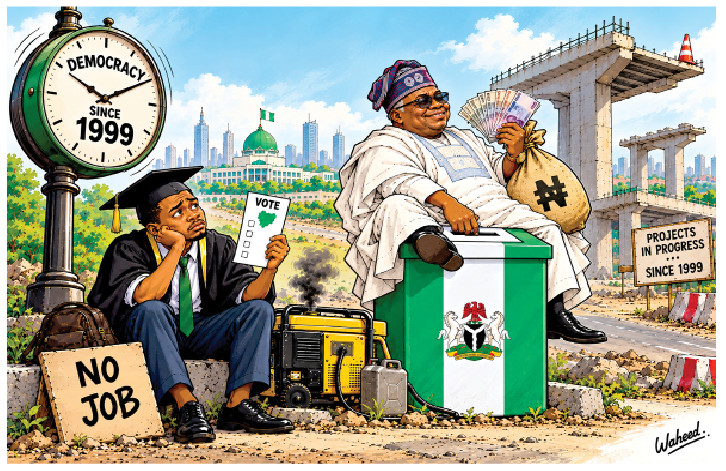
Think of a Nigerian born in 1999, the year civilian rule came back. That person is twenty-seven now. They have never lived under a military government. But they may have finished school and not found a job. They have probably learned to plan trips around insecurity, and they almost certainly run a generator at home. Democracy has been part of their whole lives. Whether it has given them any real say over that life is another matter.
That is Nigeria’s Fourth Republic. Civilian government has lasted, but citizens’ power over it remains uncertain. We should instead count how often institutions protect ordinary people, public money becomes public benefit, and those who abuse power face consequences.
The continuity trap
Continuity matters. Our earlier republics were cut short by soldiers. Since 1999, civilian rule has survived successive handovers, including 2015, when President Goodluck Jonathan lost and conceded. But survival is the beginning of democratic development, not proof of its completion.
Democratic continuity means civilian rule keeps going. Consolidation means its limits can be relied upon. Presidents accept restraint. Opposition parties can compete. Judges rule without intimidation. Citizens obtain justice without a godfather. Democracy matures when those protections hold precisely when powerful people would prefer to ignore them.
The test comes after elections. Can winners tolerate scrutiny? Can supporters acknowledge their leaders’ wrongdoing? Can losers accept credible results without feeling excluded from the country? Rules must prevent loyalty from becoming immunity.
Time alone cannot deliver that. Institutions can grow older without growing stronger. Repeated elections may teach politicians to respect competition, or simply to manipulate it better. What does the system learn, and who benefits?
That is the continuity trap. A system that rewards its insiders gives them little reason to change it. Politicians who benefit from expensive nomination forms, opaque campaign funding, and weak oversight have little incentive to widen access. Each election that renews their influence confirms that the arrangement works. What citizens experience as dysfunction, insiders regard as a successful bargain.
Its costs are scattered; rewards are concentrated. One community loses a clinic, another a road. Beneficiaries know what reform could cost them. Citizens must connect their separate disappointments into sustained demands for better government.
This explains how we can have so much politics and so little service. Parties organise lavish conventions while hospitals lack medicines. Legislatures approve budgets while communities cannot identify contractors behind abandoned projects. Renewing power receives more attention than making it answerable.
When democracy meets daily life
Institutions should correct that imbalance. Electoral bodies protect voters’ choices; legislatures scrutinise executives; courts defend rights. Their independence has a practical test: can they act when doing so inconveniences those who appoint or fund them?
The 2023 presidential election exposed the stakes. Results did not appear on INEC’s Results Viewing Portal as promptly as expected. European Union observers reported that upload failures and poor communication weakened trust. This did not, by itself, establish electoral fraud. It left citizens struggling to verify the connection between ballots and announced results. Technology builds confidence only when institutions explain failures and enable verification.
Courts legitimately resolve disputes, but litigation cannot replace an electoral process voters can check. Anti-corruption agencies likewise need consistent standards, regardless of party affiliation.
Insecurity, logistical failures and distrust discourage voting. Yet organised political machines do not withdraw when citizens grow disappointed. Staying home can strengthen the networks people distrust. Rebuilding confidence and sustaining participation go hand in hand.
Nigerians can believe in democracy while losing faith in those governing in its name. Frustration often expresses a demand that democracy deliver, rather than a wish to abandon it.
For a parent choosing between food and school fees, or a farmer afraid to reach his land, citizenship must mean something in daily life. Security and functioning services give democratic promises substance.
Prosperity cannot excuse repression; hardship does not invalidate elected government. Difficult reforms need honest explanation, fair burdens, protection for vulnerable households and a willingness to correct mistakes.
The 2023 Naira redesign offers a lesson. President Muhammadu Buhari acknowledged implementation difficulties in his February broadcast. Whatever the stated aims, the shortage of usable cash exposed the distance between official timetables and people’s capacity to cope. Reform must work for someone buying food, paying transport fares or keeping a small business open.
Leaders asking citizens to sacrifice should curb their own excesses. Criticism deserves answers. Admitting that a policy needs adjustment is part of responsible government.
The “japa” debate reflects this crisis of confidence. Migration has many causes, but patriotic appeals cannot make staying worthwhile. Safety, opportunity and institutions that reward effort fairly can.
Elite capture makes that harder. Defection can be legitimate, but parties organised around proximity to power offer little dependable policy choice. Open finances, credible internal contests and clear programmes would improve representation.
Women, young people and candidates without wealthy sponsors need realistic routes into office. Our diversity also requires secure citizenship: people must be able to criticise leaders from their communities without being treated as traitors.
Bringing authority closer to citizens can improve responsiveness, but governors can abuse power too. Any transfer of money or security responsibilities needs enforceable safeguards and accessible remedies.
Two demands that make power answerable
The Second Niger Bridge, commissioned in May 2023 after years of planning and development, shows that civilian government can deliver substantial infrastructure. The lesson is to make completion routine and maintenance dependable. Citizens should not have to await a departing administration’s legacy ceremony to see their needs addressed.
First, amend electoral law to require publication of polling-unit result images and corresponding collation records within defined deadlines, with documented procedures for technical failures. INEC should publish an independent technical audit after every general election. Breaches should trigger enforceable sanctions, subject to due process. Voters deserve a verifiable chain from ballot to declaration.
Second, require every federally funded capital project to have a public identifier linking its appropriation, contractor, contract value, payments and independently verified completion status. Publish these records on a searchable portal, updated quarterly, with penalties for withholding or falsifying information. Citizens should be able to follow a project from budget approval to a working service.
These demands give journalists, professional bodies and communities evidence to challenge official claims between elections. A residents’ association asking why a funded borehole remains dry is doing democratic work. Such questions turn frustration into pressure officials must answer.
Authoritarian rule offers no dependable shortcut. Removing scrutiny removes tools for correcting failure. Nigeria must repair democratic government while protecting the freedoms that make repair possible.
Reform must outlast a government’s honeymoon. Leaders need to accept safeguards that constrain them. Citizens must defend those safeguards when their preferred party is in power. Otherwise, accountability remains something we demand only of opponents.
Twenty-seven years have given Nigeria experience and repeated opportunities to improve. They have also exhausted the excuse that our democracy is too young to face serious standards.
The generation born in 1999 deserves more than a life without soldiers in power. It deserves a government it can influence, institutions it can trust, and a country where hard work leads to a real future. We should judge the next Democracy Day by how far we have moved towards that. Nigeria has kept the clock running. Now it must make the years count.
– Dr Dakuku Peterside, a leadership and management expert, wrote Leading in a Storm.
We’ve got the edge. Get real-time reports, breaking scoops, and exclusive angles delivered straight to your phone. Don’t settle for stale news. Join THISTIMES on WhatsApp for 24/7 updates →
Join Our WhatsApp Channel