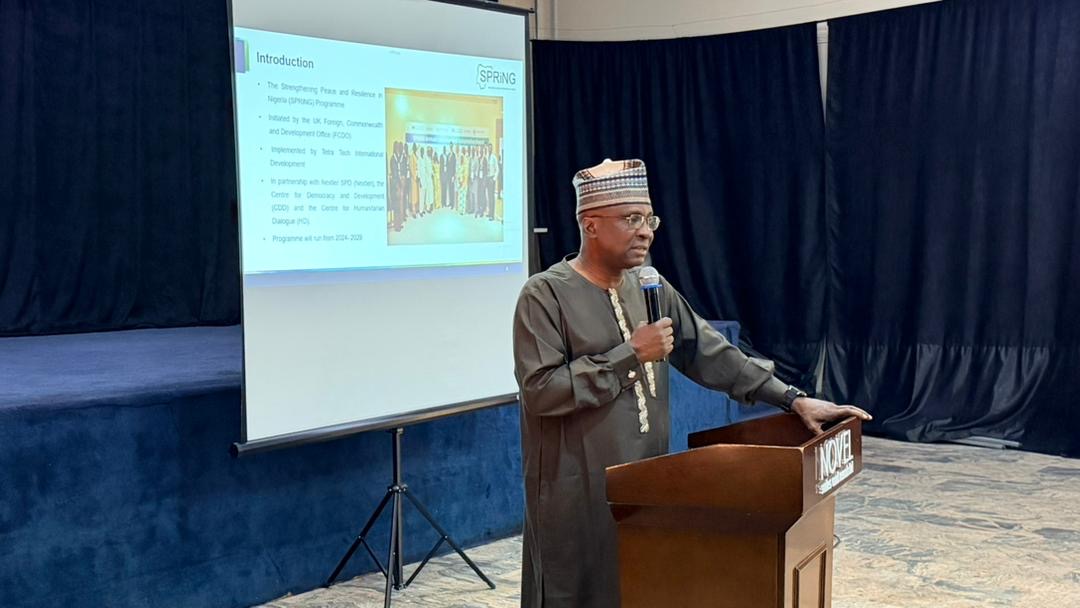
The Team Leader of a UK government-funded peacebuilding programme operating in Nigeria has declared that sexual and gender-based violence (SGBV) and other criminal offences must never be subjected to informal mediation.
This is even as the initiative launched its third year of operations with tightened safeguarding standards and a strategic shift toward scaling proven interventions.
Dr. Ukoha Ukiwo, who leads the Strengthening Peace and Resilience in Nigeria (SPRiNG) Programme, issued the directive at a three-day co-creation workshop held simultaneously in Plateau and Katsina States last week, completing a nationwide Year 3 planning rollout that had earlier convened sessions in Makurdi and Kaduna.
“As we transition into Year 3, our mandate is clear: we are shifting from experimenting with new models to aggressively scaling proven pilots,” Dr. Ukiwo told participants drawn from state government, civil society, and implementing partner organisations.
“Our success depends on deep institutional collaboration and an unwavering commitment to systemic inclusion. We must be resolute in our standards, assuring that all interventions are strictly survival-centered and that criminal offences like SGBV are never mediated informally.”
He added that while rigorous baseline targets would govern the programme’s focus to maximise impact, it would maintain the adaptive flexibility needed to support local momentum.
Funded by the UK Foreign, Commonwealth and Development Office (FCDO), the SPRiNG Programme is a four-year initiative running from 2024 to 2028, implemented by Tetra Tech International Development in partnership with Nextier SPD, the Centre for Democracy and Development (CDD), and the Centre for Humanitarian Dialogue.
Nigeria holds a top-priority designation under the UK’s global Women, Peace and Security National Action Plan covering 2023 to 2027, and the Year 3 workshops marked a decisive institutional turn away from piloting new models and toward consolidating and expanding what has already worked on the ground.
Programme leaders and stakeholders refined strategies across three integrated workstreams at the workshop.
The first targets peace, security, and justice institutions, focusing on improving coordination of existing Early Warning and Early Response platforms and operationalising standard operating procedures for community security outfits.
Efforts will align strictly with state architectures, including the Plateau State Peace Building Agency, targeting Jos North, Jos South, Mangu, Riyom, Barkin Ladi, and Wase.
The second workstream centres on Women, Youth, Peace and Security, prioritising the operationalisation of local action plans to elevate female and youth representation in security decision-making, strengthening survival-centered responses to sexual violence, and delivering market-driven economic resilience programmes for vulnerable groups.
The third addresses agriculture, pasture, and natural resource management scaling climate-smart infrastructure and agropastoral resource management initiatives that reduce friction between farming and herding communities.
A proof-of-concept from Year 2 drew significant attention at the workshop. A women’s forage cooperative in Plateau State successfully minimised conflict between nomadic herders and host farming communities and produced a milk-based derivative now branded as “Peace Yogurt.”
Programme leadership cited it as a celebrated model and template for future community-level interventions in Year 3.
To ensure equitable impact across all programme states, SPRiNG announced stringent minimum operational standards for all upcoming partner projects.
Proposals must demonstrate a survival-centered approach and meet a mandatory baseline threshold of at least 40 percent female beneficiaries and five percent women with disabilities.
The programme has also instituted a zero-tolerance policy for what it described as “GEDSI-blind” interventions those that fail to account for structural exclusion and systemic gender disparities.
To prevent the fatigue of parallel structures, stakeholders at the workshop recommended integrating SPRiNG initiatives directly into pre-existing peace committees managed by the Plateau State Peace Building Agency, rather than creating competing platforms.
Programme leadership and state representatives mutually agreed that early and consistent institutional integration is critical to long-term sustainability.
Participating organisations will undergo comprehensive training on the programme’s Monitoring, Evaluation and Learning frameworks, using standardised indicators and real-time adaptation logs to measure tangible impact across all participating states.
We’ve got the edge. Get real-time reports, breaking scoops, and exclusive angles delivered straight to your phone. Don’t settle for stale news. Join THISTIMES on WhatsApp for 24/7 updates →
Join Our WhatsApp Channel