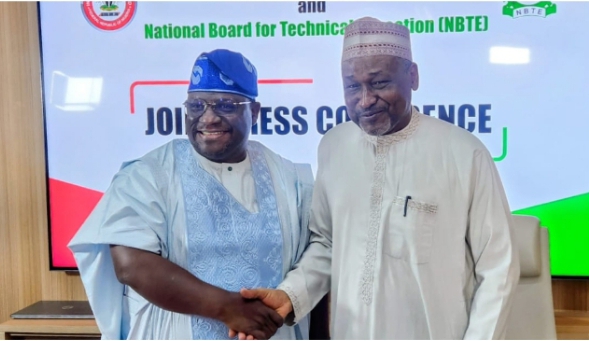
The Industrial Training Fund (ITF) and the National Board for Technical Education (NBTE) have ended a long-running dispute over their respective mandates, unveiling a unified framework that clearly defines their roles in Nigeria’s skills development architecture and is expected to strengthen technical and vocational education, improve workforce quality and support the country’s industrialisation agenda.
The breakthrough was announced on Thursday during a joint world press conference in Abuja by the leadership of both agencies, marking the formal resolution of years of institutional overlap over the regulation and implementation of the Nigerian Skills Qualification Framework (NSQF). The agreement establishes a clearer governance structure for skills development by separating responsibility for formal technical education from industry-led and informal skills training.
The framework, endorsed by the National Council on Skills chaired by Vice President Kashim Shettima, assigns the National Board for Technical Education responsibility for regulating Technical and Vocational Education and Training (TVET) within the formal education system, including polytechnics, monotechnics, technical colleges and related institutions. The Industrial Training Fund will oversee the Nigerian Skills Qualification Framework, apprenticeships, artisanship, recognition of prior learning, industry-based skills development and the transition of trainees into the labour market.
Addressing journalists, the Director-General of the ITF, Dr. Afiz Oluwatoyin Ogun, described the agreement as a landmark institutional reform that finally resolves years of uncertainty over the responsibilities of both agencies and lays the foundation for a more coordinated national skills development system.
“The President has ended the age-long confusion. Formal skills remain under the Ministry of Education through the NBTE, while informal skills development and industry linkage are now clearly the responsibility of the ITF,” Ogun said.
He said the reforms would reposition Nigeria’s workforce development strategy by shifting emphasis from academic qualifications to competency-based training driven by industry demand.
According to him, the ITF will strengthen apprenticeship programmes, expand industry partnerships, coordinate recognition of prior learning and ensure that skills acquired outside the formal education system receive nationally recognised certification under the Nigerian Skills Qualification Framework.
Ogun said the Fund would also establish a comprehensive national database of artisans, technicians and other skilled workers to improve workforce planning, certification, quality assurance and employer access to verified professionals.
He disclosed that the database would eventually support a digital marketplace through which households, businesses and industries could verify the qualifications, certification status and service records of artisans before engaging them.
Despite Nigeria’s high unemployment rate, Ogun said the country continues to depend heavily on skilled workers from Ghana, Togo, Benin Republic, Bangladesh, Pakistan and India to execute technical jobs across key sectors of the economy.
“The problem is not the absence of jobs. The challenge is the shortage of employable skills,” he said.
He noted that while only about seven per cent of Nigeria’s workforce is employed in the formal white-collar sector, approximately 93 per cent operate within the informal economy, making investment in technical and vocational skills essential to improving productivity, creating jobs and driving economic growth.
The Executive Secretary of the NBTE, Prof. Idris Bugaje, said the agreement represents one of the most significant reforms of Nigeria’s technical education system in recent years, ending an institutional conflict that had slowed the development of a coordinated national skills ecosystem.
“We are now going to work as one system, serving one government and pursuing the same national objectives. This is a major achievement because the conflict over the regulation of the Nigerian Skills Qualification Framework is now over,” Bugaje said.
He said the collaboration would strengthen Technical and Vocational Education and Training by expanding industrial attachment programmes, increasing industry participation in curriculum delivery and ensuring that graduates acquire practical skills required by employers.
Bugaje lamented Nigeria’s continued dependence on foreign skilled workers despite its large unemployed population, citing the engagement of thousands of expatriate workers during the construction of the Dangote Refinery as evidence of the country’s shortage of certified technical manpower.
He said countries such as India and Bangladesh have built multi-billion-dollar export industries around skilled labour and expressed confidence that Nigeria could achieve similar outcomes through sustained investment in internationally recognised technical skills and certification.
As part of the reforms, Bugaje disclosed that the Secretariat of the National Council on Skills and the WorldSkills Nigeria Secretariat had been transferred to the ITF to deepen collaboration between government, training institutions and industry.
He also announced the establishment of a WorldSkills Academy in Abuja to train instructors, master craftsmen and technical educators to international standards before deploying them to train students, apprentices and artisans nationwide.
Responding to questions from journalists, Ogun confirmed that the academy, located at the ITF’s Modern Skills Training Centre in Abuja, is undergoing renovation and equipment upgrades ahead of its formal inauguration.
He said the facility would also serve as Nigeria’s training hub for future WorldSkills competitions following the country’s recent admission into the global WorldSkills network.
Both agencies expressed confidence that the new governance framework would eliminate institutional duplication, improve policy coordination, raise the quality of technical education, deepen industry participation in skills development and position Nigeria as a competitive source of certified skilled manpower for domestic and international labour markets.
We’ve got the edge. Get real-time reports, breaking scoops, and exclusive angles delivered straight to your phone. Don’t settle for stale news. Join THISTIMES on WhatsApp for 24/7 updates →
Join Our WhatsApp Channel