- Tributes as Alhaji Abubakar Alhaji is laid to rest in Sokoto
- He made immense contributions to national development–Northern govs
- He was one of Arewa’s brilliant sons – ACF
- The Extraordinary Life And Enduring Legacy Of Sardaunan Sokoto
By AZA MSUE, Kaduna, Abdullahi Olesin, Ilorin
The Northern Nigeria Governors’ Forum (NNGF) has expressed grief over the demise of former Nigerian High Commissioner to the United Kingdom, Alhaji Abubakar Alhaji (Sardaunan Sokoto).
In a condolence message, the chairman of the Forum and Governor of Gombe State, Muhammadu Inuwa Yahaya, described the late Alhaji Alhaji as an accomplished public servant and respected elder statesman who made immense contributions to national development through decades of exemplary service.
Governor Yahaya said the death of Alhaji Abubakar Alhaji is a huge loss not only to his family and the people of Sokoto State but also to Northern Nigeria and the nation, which benefited immensely from his vast experience, exemplary leadership and invaluable counsel.
Also, the apex northern socio-cultural organisation, Arewa Consultative Forum (ACF), has mourned Alhaji, who died at the age of 88.
In a short condolence message sent to LEADERSHIP Friday, ACF national publicity secretary, Prof. Tukur Muhammad Baba, described the death of Sardaunan Sokoto as a great loss.
While condoling with the Sultan Council, government, and people of Sokoto, ACF said that Arewa had lost one of its brilliant sons.
Emir of Ilorin Expresses Sorrow
The Emir of Ilorin, Alh Ibrahim Sulu-Gambari, has expressed sorrow over the passing of the Sardaunan Sokoto and former minister of Finance, Alhaji Abubakar Alhaji.
Sulu-Gambari said his death is a monumental loss not only to the Sokoto Caliphate and Northern Nigeria, but to the entire country.
The Emir said that the deceased was a bridge between the government, the traditional institution, and the people.
In a condolence message issued by his spokesman, Dr Abdulazeez Arowona, the Emir noted that Alhaji Alhaji distinguished himself as a minister of State for Budget and Planning in 1988 and later as minister of Finance between 1990 and 1991, and also served meritoriously as Nigeria’s High Commissioner to the United Kingdom from 1992 to 1996.
Sulu-Gambari added: “As Sardaunan Sokoto, a title he held since 1990, succeeding the late Sir Ahmadu Bello, the deceased provided wise counsel and remained a stabilising force within the traditional institution.
“ On behalf of the Ilorin Emirate and the Kwara State Traditional Rulers Council, I extend my heartfelt condolences to the Sultan of Sokoto, Alh Muhammad Sa’ad Abubakar III, the Sokoto Emirate Council, the family of the deceased, and the Government of Sokoto State.
“I prayed to the Almighty Allah to forgive the late Sardaunan Sokoto, accept his good deeds, and grant him Al-Jannah Firdaus and fortitude for the family to bear the irreparable loss.”
Shettima, Dignitaries Gather At Funeral
BY NICHOLAS DEKERA
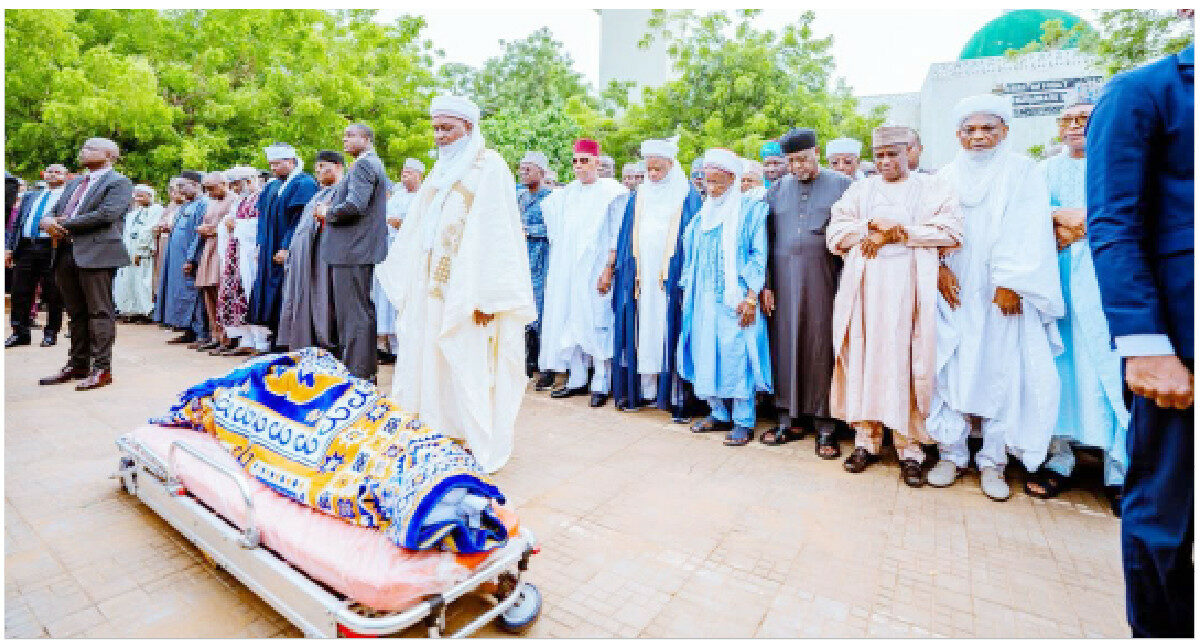
Nigeria’s former minister of Finance and the Sardaunan Sokoto, Alhaji Abubakar Alhaji, was buried yesterday in Sokoto, Sokoto State.
The burial was attended by Nigeria’s Vice President, Kashim Shettima, and the Sultan of Sokoto, Alhaji Muhammadu Sa’ad Abubakar III, former governor of Sokoto State, Senator Aminu Waziri Tambuwal, among several others.
Alhaji passed away yesterday in Abuja.
Alhaji, a renowned technocrat and elder statesman, served as Nigeria’s Minister of Finance between 1990 and 1991 under the military administration of General Ibrahim Babangida.
He had earlier served as Minister of State for Budget and Planning in 1988.
He also served as Secretary to the Government of the Federation and as Nigeria’s High Commissioner to the United Kingdom.
A career civil servant, he held several key positions in the civil service and corporate sector during his over three decades of public service.
As Sardaunan Sokoto, he was one of the most revered traditional title holders in the Sokoto Caliphate.
He was turbaned in 1990, a title that had remained vacant since the death of Sir Ahmadu Bello in 1966. He played major roles in community development, diplomacy and national affairs.
Tributes have continued to pour in from across the country, with political leaders, traditional institutions and associates describing him as a patriot, an excellent administrator and a bridge builder.
The Extraordinary Life And Enduring Legacy Of Sardaunan Sokoto
By IGHO OYOYO, Abuja
The death of Alhaji Abubakar Alhaji (Triple A), the Sardaunan Sokoto and one of Nigeria’s most distinguished public administrators, has drawn the curtain on the life of a man whose career spanned the highest levels of the nation’s civil service, diplomacy, economic management and traditional leadership.
Revered across government circles as ‘Triple A,’ he was widely regarded as one of the last surviving members of the elite generation of Super Permanent Secretaries whose professionalism, intellect and integrity shaped Nigeria’s post-independence public administration.
For more than three decades, Alhaji served the country with uncommon distinction, rising from a young Assistant Secretary in the Federal Ministry of Finance to Permanent Secretary, cabinet minister, diplomat and eventually the prestigious Sardaunan Sokoto.
Throughout his remarkable journey, he earned a reputation as a disciplined technocrat, an astute economist and a quiet but influential statesman whose contributions left an indelible mark on Nigeria’s governance.
Born on 12th November, 1938, in Dogon Daji, present-day Sokoto State, Alhaji came from an eminent family with strong links to the Sokoto Caliphate.
His father, Alhaji Muhammed Sani, was a descendant of the family of Sheikh Usman Dan Fodio, the founder of the caliphate.
From an early age, he combined Islamic education with Western learning, reflecting the values of scholarship and discipline that would define his public life.
He attended Government College, Katsina, where he excelled academically before proceeding to the United Kingdom on a government scholarship.
At Bournemouth College of Commerce and later the University of Reading, Berkshire, he studied Political Economy, equipping himself with the academic foundation that would shape his distinguished career in economic management.
Determined to broaden his knowledge, he later undertook advanced studies at The Hague Institute of Social Studies in the Netherlands and the International Monetary Fund Institute in Washington, D.C., where he acquired specialised training in development and international finance.
His entry into the Federal Civil Service in 1964 marked the beginning of an extraordinary career.
Starting as an Assistant Secretary in the Federal Ministry of Finance, Alhaji quickly distinguished himself through diligence, analytical ability and a mastery of public finance.
Over the years, he served in several strategic ministries, including Finance, Industries, Trade, Budget and National Planning, earning the respect of colleagues and political leaders alike.
The defining phase of his career came with his appointment as Permanent Secretary of the Federal Ministry of Trade in 1975.
Four years later, he returned to the Federal Ministry of Finance as Permanent Secretary, one of the most influential positions in the Nigerian bureaucracy.
It was during this period that he became widely known as “Triple A,” a nickname that reflected both his initials and the exceptional esteem in which he was held throughout government circles.
Among civil servants of his generation, Triple A was regarded as the embodiment of professionalism.
He belonged to the celebrated class of “Super Permanent Secretaries,” senior bureaucrats whose institutional knowledge and technical competence ensured continuity in governance despite changes in political leadership. They were trusted advisers who provided objective policy guidance and safeguarded the integrity of the civil service.
As Permanent Secretary in the Ministry of Finance, Alhaji occupied the centre of Nigeria’s economic policymaking during a period of rapid industrial expansion and increasing international engagement.
He played key roles in negotiating bilateral and multilateral trade agreements that supported Nigeria’s industrialisation agenda.
His expertise proved invaluable during negotiations for the Lomé Convention, which strengthened trade and development cooperation between the European Economic Community and countries in Africa, the Caribbean and the Pacific.
His contributions also extended to landmark industrial projects that symbolised Nigeria’s ambition to become a leading manufacturing economy.
He participated in negotiations that culminated in agreements for the Ajaokuta Steel Complex and the Delta Steel Company, two projects expected to transform the nation’s industrial base. In addition, he managed sensitive discussions with international creditors, helping Nigeria navigate increasingly complex financial obligations amid economic uncertainty.
Colleagues often described Triple A as meticulous and intellectually rigorous. He was known for studying government files in extraordinary detail, insisting on precision in policy documents and encouraging evidence-based decision-making.
Yet behind his firm administrative style was a humble mentor who invested time in developing younger officers. Many retired directors and permanent secretaries have acknowledged that they learned the principles of integrity, discipline and professional excellence under senior administrators such as Alhaji Abubakar Alhaji.
His remarkable achievements in the civil service naturally led to his appointment to the Federal Executive Council. In 1988, he was named Minister of State for Budget and Planning by the administration of General Ibrahim Babangida, and later served as Minister of Finance during one of the most challenging periods in Nigeria’s economic history.
The country faced declining oil revenues, mounting external debt and difficult economic reforms that demanded prudent fiscal management and careful engagement with international financial institutions.
Although the policies of that era generated considerable national debate, Alhaji approached his responsibilities with characteristic calmness and professionalism.
His deep understanding of public finance and years of administrative experience enabled him to provide steady leadership during a difficult period for the Nigerian economy.
Following his service in government, he represented Nigeria as High Commissioner to the United Kingdom, where he worked to strengthen diplomatic and economic relations between both countries.
His vast experience in governance and international affairs earned him respect within diplomatic circles and reinforced his reputation as one of Nigeria’s most accomplished public servants.
In April 1990, Alhaji Abubakar Alhaji received one of the highest honours in the Sokoto Caliphate when he was turbaned as the Sardaunan Sokoto, succeeding to the prestigious title once held by the late Sir Ahmadu Bello, the Premier of Northern Nigeria.
The conferment recognised not only his noble lineage but also his decades of distinguished service to the nation. As Sardaunan Sokoto, he served as a bridge between traditional institutions and modern governance, promoting unity, education, and responsible leadership.
Even after retirement from active public service, Triple A remained an influential elder statesman whose opinions on governance and economic policy continued to attract national attention.
He openly questioned aspects of Nigeria’s privatisation programme, arguing that strategic national assets should not be relinquished without due consideration of the country’s unique circumstances.
He also maintained that competent leadership, strong institutions and accountable governance were more important to Nigeria’s progress than endless political restructuring.
Despite the enormous influence he wielded during his career, Alhaji remained remarkably modest. Associates often remarked that he preferred a simple lifestyle, choosing dignity and honour over ostentation.
His humility, honesty and devotion to public service distinguished him from many public officials of his generation and earned him admiration across political, regional and religious divides.
With his passing, Nigeria has lost one of its finest technocrats and one of the most respected figures in the history of the Federal Civil Service. His legacy is preserved in the institutions he helped strengthen, the economic policies he shaped, the international agreements he negotiated and the countless public servants he mentored throughout his career.
Alhaji Abubakar Alhaji’s life was a testament to the enduring value of integrity, competence and selfless service. As a Super Permanent Secretary, minister, diplomat and Sardaunan Sokoto, he exemplified the highest ideals of leadership and public administration.
His remarkable journey from a young civil servant to one of Nigeria’s most respected politicians remains an enduring inspiration for future generations committed to building a stronger, more accountable and more prosperous nation.
We’ve got the edge. Get real-time reports, breaking scoops, and exclusive angles delivered straight to your phone. Don’t settle for stale news. Join THISTIMES on WhatsApp for 24/7 updates →
Join Our WhatsApp Channel