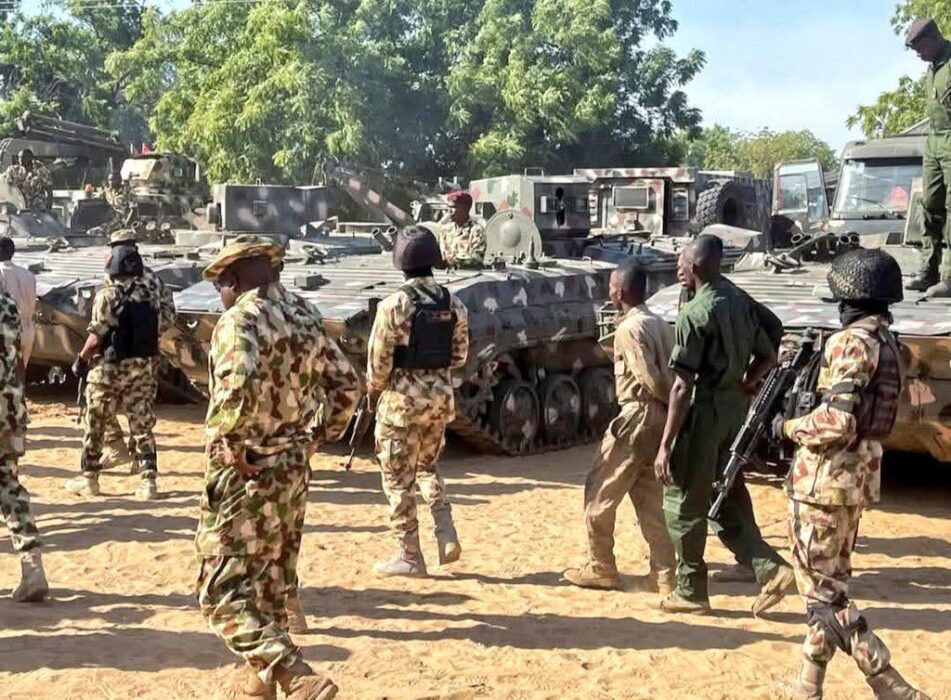
Retired military officers and security experts have said the sacrifice of a soldier cannot be measured in monetary terms, but advocated an entry-level salary of between N200,000 and N250,000.
They, however, noted that such a salary remains subject to prevailing economic realities. According to them, no fighting troop deserves to go into battle on an empty stomach.
Their recommendations come after the Minister of Defence, General Christopher Musa (rtd), revealed that President Bola Tinubu will soon announce a salary increase for soldiers, despite a recent increment from N49,000 to N100,000.
Air Vice Marshal Olatokunbo Adesanya (rtd), former Nigerian Air Force spokesman and former Nigerian Defence Attaché to Russia, said determining an appropriate entry-level salary for soldiers requires balancing two critical factors: economic realities and fiscal constraints arising from limited resources.
He said: “Looking strictly at current cost-of-living indicators, my view is that the entry-level soldier’s basic pay should ideally be between N200,000 and N250,000 monthly.
“Nevertheless, if fiscal constraints prevent the treasury from meeting that cash threshold immediately, the entry-level wage should, at a minimum, target between N150,000 and N180,000, backed by reliable welfare schemes such as housing, healthcare and family education to restore the troops’ true purchasing power.
“No fighting troop should be allowed to fight on an empty stomach or be distracted by how to meet the basic needs of his immediate family.”
Former Army spokesman, Brig.-Gen. Sani Kukasheka Usman (rtd), said no amount of money can be compared with the sacrifices made by a soldier.
“How much value can you place on the sacrifices, in monetary terms, of the life and service of an average soldier? Do you have the money? No amount of money can pay for that.”
He said the young men who lay down their lives for the peace of the nation deserve to be adequately compensated.
“So, no amount of money or incentive can compensate for human life. However, we understand the prevailing global economic circumstances.
“And, of course, Nigeria is uniquely affected. At the same time, I know successive governments have been doing their best to ensure that members of the Armed Forces are taken care of by increasing allowances and salaries. If you ask me, I will say it is not enough. Hence, the need to further enhance it in line with current realities.”
He reiterated that while no amount of money is enough, “We have to be realistic.
“What is available to the government? What can Nigeria afford? So, it should be a work in progress, with periodic reviews to enhance it. It might not necessarily be an increase in salary, but it can be complemented with other social welfare programmes.”
He added that while the government may not be able to meet every financial expectation, it can support soldiers by providing basic necessities such as housing and other welfare packages.
The managing director of Beacon Security and Innovations Limited, Dr Kabir Adamu, also said the salary review for soldiers is long overdue in view of prevailing economic realities.
“This new review is overdue. At N100,000 a month, a soldier’s minimum pay sits barely above Nigeria’s civilian minimum wage of N70,000, an unacceptably thin premium for personnel who face life-threatening duties against insurgency, banditry and kidnapping on a daily basis.”
Citing inflation, he said no soldier should earn less than ₦200,000 as a minimum salary.
He explained: “With food inflation still climbing, even as headline inflation eases to below 16 per cent, and with labour unions already demanding a civilian minimum wage of ₦154,000, any new military salary benchmark must be set well above that figure simply to preserve a meaningful risk premium, let alone restore lost purchasing power.
“A defensible floor for soldiers’ base pay would be in the range of ₦200,000 to ₦300,000 monthly, roughly three to four times the civilian minimum wage, with additional hazard allowances for troops deployed in active conflict zones.”
He, however, noted that this must be weighed against fiscal realities.
“Gen. Musa (rtd) himself has repeatedly acknowledged that the defence budget remains inadequate even before any new wage bill, and a raise that is not matched by adequate funding for equipment, logistics and training could leave troops better paid but no safer.
“The government should therefore pair whatever figure it announces with a binding review mechanism, similar to the three-year cycle now used for civilian wages, so that soldiers’ pay does not once again quietly erode into irrelevance, as the ₦100,000 benchmark eventually did.”
We’ve got the edge. Get real-time reports, breaking scoops, and exclusive angles delivered straight to your phone. Don’t settle for stale news. Join THISTIMES on WhatsApp for 24/7 updates →
Join Our WhatsApp Channel