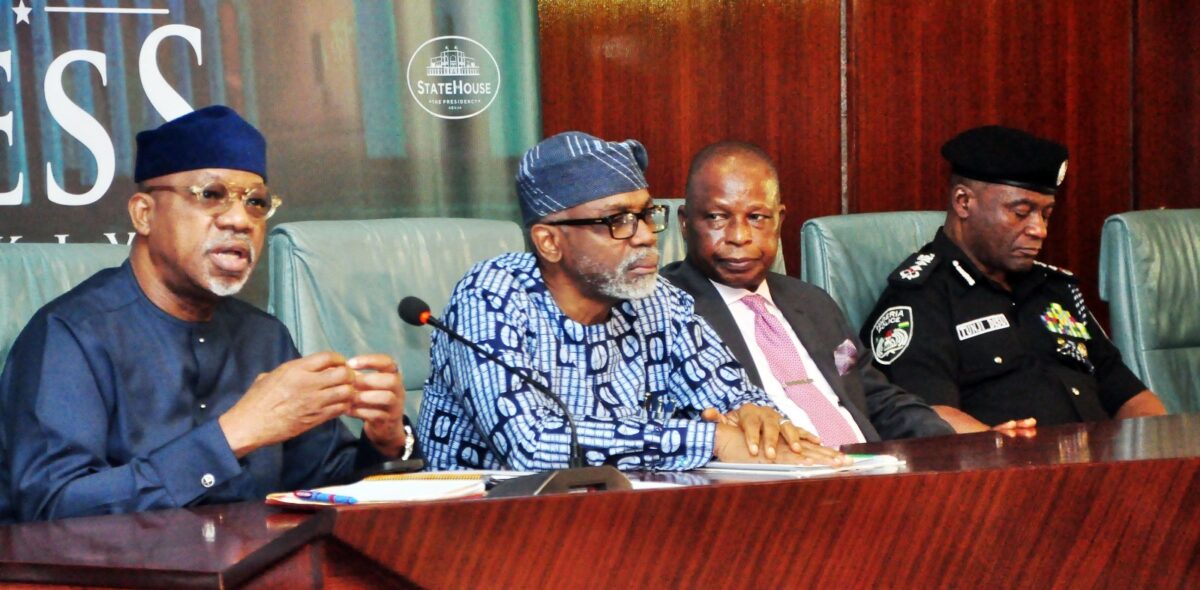
The Presidency on Monday unveiled a seven-week implementation roadmap for Nigeria’s proposed state police system, declaring that no state will be allowed to establish a police service until it meets nationally prescribed standards designed to guarantee professionalism, accountability and the protection of citizens’ rights.
Speaking to State House correspondents after convening the inaugural meeting of the Presidential Working Group on the National Policing Bill, the Chief of Staff to the President and Chairman of the Working Group, Femi Gbajabiamila, said President Bola Tinubu had constituted the body to produce an implementation-ready legal framework for state policing before the constitutional amendment creating the system comes into force.
Gbajabiamila said the working group had commenced work on what he described as one of Nigeria’s most significant governance and security reforms, aimed at creating a lawful, professional and sustainable dual policing architecture.
“This is a monumental reform that Nigerians have debated over for many years,” he said.
“The question before the country is how we transform our policing architecture to become more responsive to the realities of our communities. Our central task is now to design a lawful, professional and sustainable federal and state policing system that places greater capability closer to the people while preserving national standards, national security and the rights of every Nigerian.”
He explained that although the Senate approved the constitutional proposal on state police on June 24, 2026, and the House of Representatives passed the Executive State Police Bill on July 23, 2026, the constitutional amendment had not yet become law because it still requires approval by the required number of State Houses of Assembly.
He stressed that until that constitutional process is completed and the necessary implementing legislation enacted, no state police service exists anywhere in Nigeria.
“The Nigeria Police Force remains the constitutionally recognised police institution,” he said.
Gbajabiamila noted that the constitutional amendment merely creates the authority for federal and state policing but does not provide the operational framework required for implementation.
According to him, the proposed National Policing Bill will address issues including recruitment, certification, training, funding, command structure, jurisdiction, complaints mechanisms, human rights safeguards, firearms regulation, pensions, data management, federal-state cooperation and transition arrangements.
He disclosed that the assignment includes a comprehensive audit of the Police Act 2020, the Police Service Commission framework, police regulations and other laws affected by the proposed reform.
The review, he said, will also cover national minimum policing standards, objective assessment of state readiness, federal-state and interstate cooperation, independent complaints institutions, rank equivalence, transfer and pension portability, forensic and criminal information systems, firearms control, funding arrangements, federal intervention procedures and the transfer of existing security assets, liabilities and pending cases.
Gbajabiamila said the Working Group comprises representatives of the Presidency, the Federal Ministry of Justice, the Office of the National Security Adviser, the Nigeria Police Force, the Nigeria Governors’ Forum and the Nigerian Bar Association.
He added that President Tinubu had also approved a multidisciplinary Policy Advisory Committee chaired by Mohammed Abdullahi Liman, with members drawn from the judiciary, academia, security agencies, justice sector, technology experts, the National Assembly, state attorneys-general and other stakeholders.
According to him, the committee will provide independent policy and technical oversight, review successive drafts of the proposed legislation and validate the implementation, fiscal and transition plans before they are presented to the President.
The Chief of Staff announced that the implementation programme would run from July 27 to September 14, 2026, while the Executive Bill package is expected to be presented to President Tinubu on September 3.
He said the timetable was demanding but would not compromise the quality of the work.
“The final package will comprise more than a Bill. It will include schedules, an explanatory memorandum, a legal audit, consequential amendments matrix, clause-by-clause analysis, state readiness framework, fiscal and implementation notes, validation report, risk register and controlled digital archive.”
Gbajabiamila said the government was determined to ensure that decentralised policing does not undermine national cohesion or become susceptible to abuse.
“State Police cannot mean thirty-six state militias, just as national standards cannot become a disguised method of re-centralising day-to-day state policing,” he said.
“No political officeholder should be able to direct the arrest of an opponent, suppress lawful political activity or selectively enforce the law.”
He stressed that operational commencement of any state police service would depend strictly on demonstrated capacity.
“A proposed State Police Service must demonstrate that it has credible arrangements for recruitment, vetting, training, pay, pensions, equipment, custody, complaints, discipline, data, firearms control, independent oversight and financial sustainability before it begins policing.
“National standards will be the baseline. States may establish higher standards. However, no Nigerian should receive a lower standard of protection because of where they reside.”
Gbajabiamila also announced an open call for memoranda, position papers and practical proposals from Nigerians, civil society organisations, professional bodies and other stakeholders to improve the proposed legislation.
He said submissions would be organised by theme and considered during the drafting process, while the completed draft would undergo a national consultation before the President’s final approval and subsequent transmission to the National Assembly.
Responding to questions from journalists, the Chief of Staff said it was premature to estimate the cost of implementing state police.
He said funding projections would be based on empirical research and state-by-state assessments rather than speculation.
“Giving you a cost at this stage would be pulling something out of thin air. The cost will be evidence-based and based on thorough research on a state-by-state basis,” he said.
Gbajabiamila also announced during the question-and-answer session the launch of nationalpolicingbill.com, an online platform through which Nigerians can monitor the reform process and submit memoranda, position papers and policy proposals.
According to him, submissions will remain open for about 10 days, with the possibility of an extension if necessary.
He further explained that any state unable to meet the prescribed minimum requirements would continue to be policed by the Nigeria Police Force until it acquires the necessary institutional capacity.
“There is no state that does not have capacity to establish state police. But if, for whatever reason, a state is unable to do so, the federal police remains in place until such a time when the state is able to come on board,” he said.
Also speaking, the Attorney General of the Federation and Minister of Justice, Lateef Fagbemi, said the National Policing Bill would translate the constitutional amendment into an operational legal framework.
He said the legislation would define the powers of federal and state police, provide for consequential amendments to existing laws, establish funding arrangements, determine jurisdiction over different categories of offences and make recommendations on possible federal support for states.
Fagbemi said the exercise should not be misconstrued as an attempt by the Federal Government to retain control over state policing but rather to ensure that the constitutional amendment becomes fully implementable.
Also speaking, Ogun State Governor, Dapo Abiodun described the proposed state police framework as one of the Tinubu administration’s most consequential reforms.
He said virtually every federal system operates some form of subnational policing and argued that Nigeria was long overdue for the reform.
“I do not know of any federal system anywhere in the world that operates a unitary policing structure. Nigeria is even more complex than most. In terms of international best practice, the time for state police is long overdue,” he said.
Abiodun said there was now broad national consensus on the need for state police, stressing that the country could no longer continue with the same policing model while expecting different security outcomes.
“You cannot keep trying something the same way over and over again and expecting a different result. It is time for us to begin to look at other ways to secure the lives and property of our citizens as enshrined in our Constitution,” he said.
We’ve got the edge. Get real-time reports, breaking scoops, and exclusive angles delivered straight to your phone. Don’t settle for stale news. Join THISTIMES on WhatsApp for 24/7 updates →
Join Our WhatsApp Channel