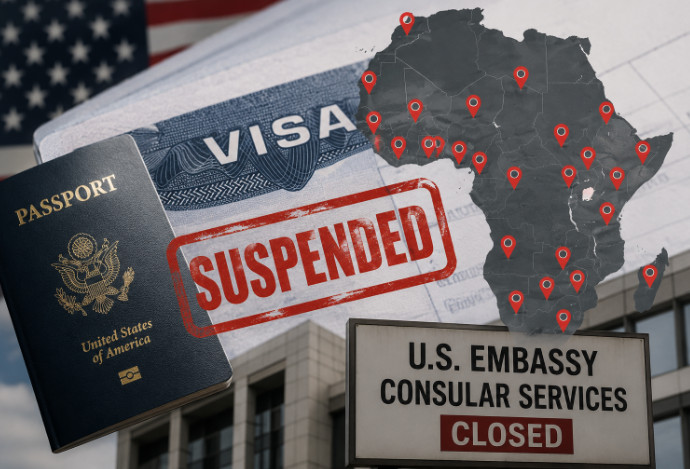
Nigerian experts in diplomacy and international affairs have called on the Federal government to take reciprocal measures against the United States over what they described as “discriminatory and ridiculous” imposition of $20,000 visa bonds against Nigerian travellers and nationals of other African countries.
Effective Monday, August 3, 2026, the United States intends to carry out its threat to compel Nigerians and other African business and tourist visa applicants to deposit up to $20,000 as a guarantee that they will depart America at the expiration of their stay.
This decision by the President Donald Trump administration was reportedly predicated on rising visa overstay cases and poor information sharing by several countries on the continent.
The rule establishes a permanent Visa Bond Programme after the pilot phase that began in August 2025.
The US Department of State said the rule, which was published Saturday was intended to address the vexed issue of the hundreds of thousands of non-immigrant visitors who remain in the US beyond what was permitted.
According to the Department, the policy targets applicants from countries “with high overstay rates, deficient information sharing, insufficient identity verification and criminal records, and that need improvement in the area of screening and vetting and the security of travel and civil documents.”
The Department linked the policy to Executive Order 14159, “Protecting the American People Against Invasion,” which directs the Treasury, State and Homeland Security departments to strengthen bond administration under US immigration law.
In a related development, the US Embassy in Nigeria has cautioned Nigerians against using AI-edited passport photos for visa applications, stating that it will not accept photos that have been edited or filtered.
“Your photo should be recent (taken within the past six months) and look like you. The TSA or CBP agent must be able to tell it’s you,” it said
Speaking to LEADERSHIP on Sunday, former Nigerian High Commissioner to Singapore, Ambassador Ogbole Ode, said the decision was aimed at shutting the doors against Nigerians and other Africans by an increasingly desperate US Government.
He advised the Nigerian government to activate the “principle of reciprocity” and impose severe measures on US visa applicants as well, including higher bond requirements.
Also speaking, public intellectual Dr Katch Ononuju, described the visa bond as “punitive and abnormal”, stressing that it is discriminatory and might not work in the long run.
Dr. Ononuju also urged the Nigerian government to hit back at the US even as he advised Nigerians to remain calm.
International Constitutional Law expert Livingstone Wechie said the decision is an opportunity for Nigeria and other African countries to rethink their strategies towards the US and find ways to enhance their global relevance rather than relying on the US.
“The US has just told Africa to stand up and take its destiny into its own hands instead of seeking validation from the West. It is a window for Africa’s turnaround and to rise to its full potential by implementing the African Continental Free Trade Agreements (AfCFTA),” he said.
Other African countries affected include Algeria, Tunisia, Benin, Cabo Verde, Côte d’Ivoire, Gambia, Guinea, Guinea-Bissau, Mauritania, Senegal, Togo, São Tomé and Príncipe.
Others include: Angola, Burundi, Central African Republic, Djibouti, Gabon, Ethiopia, Tanzania, Uganda, Botswana, Lesotho, Malawi, Mauritius, Mozambique, Namibia, Seychelles, Zambia and Zimbabwe.
The US has made the visa restrictions appear severe: during the pilot phase, 50 countries were added, and all qualified B-1/B-2 applicants were required to deposit as much as $15,000, as deemed necessary by consular officers.
The State Department noted the pilot worked, saying that overstays from the affected countries dropped to fewer than 50 in the first 10 months of the pilot phase, whereas in the full year 2024, the 50 pilot countries recorded 45,488 overstays.
The US authorities also explained that the bond would be refunded without interest once US immigration systems confirm that the traveller departed on time and complied with all visa conditions, but it would be forfeited in the event of a breach.
The State Department noted that the bond requirement also led to a sharp drop in applications. It said further that visa issuance for pilot countries fell by 83 per cent between August 2025 and July 2026, with close to half of the 20,000 applicants choosing not to pay the bond. Total bond payments during the pilot reached about $115 million, the State Department said.
US data showed non-VWP (Non-Visa Waiver Programme) countries consistently record higher overstay rates. For the full year 2024, the Department of Homeland Security reported 269,382 B-1/B-2 overstays excluding Mexico, Canada and Visa Waiver Program countries. For VWP countries, the overstay rate was 0.44 per cent, compared to 2.06 per cent for non-VWP travellers.
“The 2025 visa bond pilot, which provided a framework for the Department of State, the Department of Homeland Security, and the Department of the Treasury to assess the feasibility of administering a visa bond programme, has provided sufficient data to suggest that a visa bond programme is an effective tool for enforcing compliance among bonded visa holders,” it said.
The State Department noted the policy is not punitive but a “tool of diplomacy” to push countries to improve data sharing and document security.
“This Programme responds to… and is intended to encourage foreign governments to take immediate action to reduce the overstay rates by encouraging their nationals to comply with US immigration laws,” the notice stated.
Under the new rules, consular officers will determine the bond amount to be paid by each applicant based on individual circumstances, with the options set at $10,000, $15,000 and $20,000.
We’ve got the edge. Get real-time reports, breaking scoops, and exclusive angles delivered straight to your phone. Don’t settle for stale news. Join THISTIMES on WhatsApp for 24/7 updates →
Join Our WhatsApp Channel