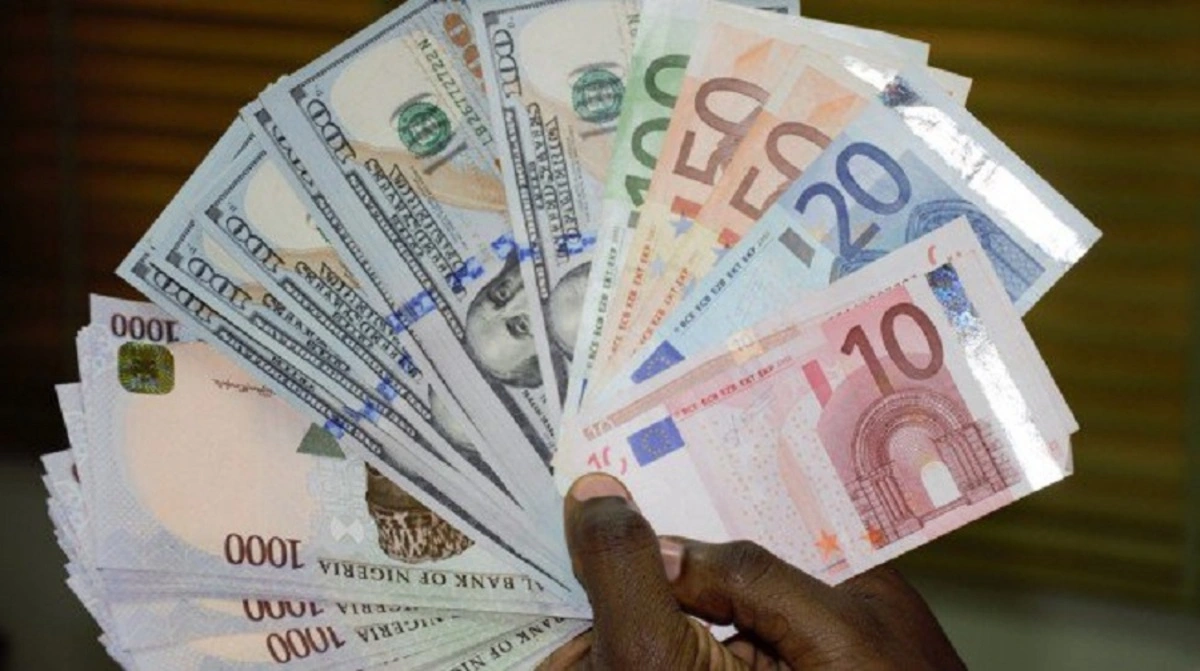
Nigerian companies are reporting record naira profits recently, especially in H1 2026, but the more revealing question is whether those earnings have recovered to pre-2023 levels when measured in dollars.
That question has become increasingly important following Nigeria’s foreign exchange reforms in 2023.
In June 2023, the Central Bank of Nigeria moved to liberalise the foreign exchange market, allowing the naira to trade more freely.
The currency subsequently depreciated sharply, raising the cost of imported inputs and increasing the naira value of foreign-currency obligations. The devaluation also triggered substantial foreign-exchange losses for companies with dollar-denominated liabilities, materially affecting profits and balance sheets across several sectors.
The average exchange rate weakened from about N425.98/$ in 2022 to N1,518.38/$ in 2025, while averaging about N1,376/$ in the first six months of 2026.
This means that between 2022 and 2025, a company needed to increase its naira profit by roughly 256% simply to maintain the same profit in dollar terms.
Against this backdrop, Nairametrics examined the earnings of major Nigerian companies to determine how much of their pre-2023 dollar profitability has been recovered.
The analysis initially screened a broader pool of companies before narrowing the comparable sample to 29 companies currently listed on the Nigerian Exchange.
To ensure consistency, the sample was restricted to companies with December year-ends, positive profit after tax in both 2022 and 2025, and actual January-to-June 2026 results.
The companies include:
Companies with different financial year-ends, those that had only released Q1 2026 results at the time of the research, and companies that moved between profits and losses were excluded from the core like-for-like comparison.
Average exchange rates of N425.98/$ for 2022, N1,518.38/$ for 2025 and N1,376/$ for H1 2026 were applied to their reported naira profits.
The findings suggest that Nigerian corporate profitability has broadly recovered to pre-2023 levels in dollar terms, although the recovery remains uneven.
The recovery was also broad at the company level. Twenty of the 29 companies, or about 69%, generated more profit in dollar terms in 2025 than they did in 2022, while nine remained below their pre-2023 levels.
By June 2026, 12 of the 29 companies had already generated more dollar profit than they recorded during the whole of 2022, while 25 had generated at least half of their full-year 2022-dollar earnings.
The H1 2026 numbers provide an even clearer indication that the recovery in dollar profitability is extending beyond 2025.
Nigerian Breweries similarly moved from N13.19 billion ($30.96 million) in 2022 to N99.10 billion ($65.27 million) in 2025, before generating N92.96 billion, or $67.55 million, in H1 2026.
Banking provides some of the clearest signs of acceleration. FCMB’s dollar PAT rose from $72.54 million in 2022 to $116.51 million in 2025, before reaching $101.64 million from N139.86 billion PAT in H1 2026.
Insurance also contributed to the group. NEM Insurance increased dollar PAT from $12.68 million in 2022 to $15.87 million in 2025, and its N18.09 billion H1 2026 profit translated to $13.15 million, already above the 2022 benchmark.
The same momentum is evident in cement and energy. WAPCO increased dollar PAT from $125.94 million in 2022 to $179.88 million in 2025, before generating N208.35 billion, or $151.41 million, in H1 2026.
The comparison shows how much of the recent surge in corporate earnings has been required simply to offset the naira’s depreciation.
The H1 2026 numbers, however, point to a stronger phase of recovery. With the companies already generating 80.8% of their entire 2022 dollar PAT in six months, and 12 firms already exceeding their full-year 2022 dollar earnings, the data suggest that more companies are beginning to move beyond merely recovering the value lost to devaluation.