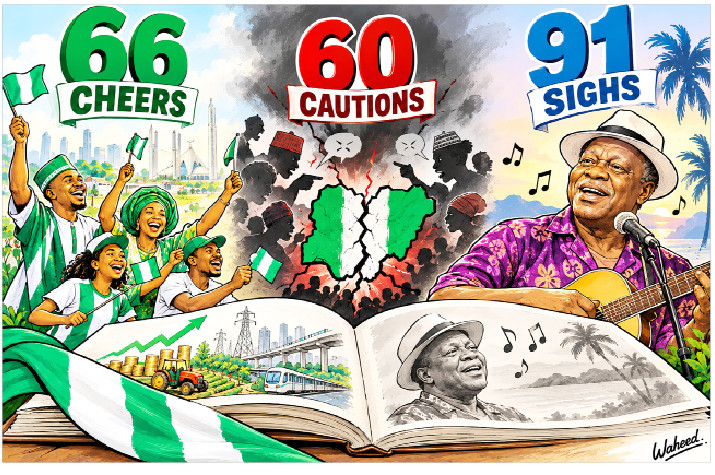
A child would probably look at Nigeria’s 66th independence anniversary from the perspective of a nursery rhyme: One, two, buckle my shoe. Three, four, shut the door; five, six, pick up sticks; seven, eight, lay them straight; nine, ten, a big fat hen. Then, he might go prosaic with numbers eleven to sixty-six before shouting, “Hip-hip-hip, hurray!”
Happy birthday, Nigeria!
Worst Is Over!
To mark the sombre celebration, President Tinubu dressed his evaluation of the present state of affairs in the garb of optimism. He acknowledged the harsh economic circumstances under which Nigerians have laboured since his government initiated painful reforms meant to reposition the country for prosperity. Like the excision of a cancerous tumour in a suffering patient, the economic measures adopted by the government have positioned the country for recovery. The worst, says the president, is over.
The president proclaimed that Nigeria had crossed its proverbial Red Sea and jettisoned the morphine of corruption-laden subsidies. He pointed to macro-level indicators—such as a GDP growth rate exceeding four percent, stabilised foreign exchange markets, and rising non-oil export revenues—to argue that the administration’s aggressive reforms have successfully repaired Nigeria’s foundational architecture.
However, it must be said that while a four percent growth rate and stabilised reserves are commendable technical milestones, they can’t pacify households grappling with cumulative inflation, high transportation costs, and steep food prices. The people are eagerly looking forward to the fulfilment of the promise to lower the cost of living and boost domestic production.
Tinubu called for unity and fortitude, framing past suffering as a mandatory advance payment for long-term economic survival. Nevertheless, he is not unmindful of the fact that his government will be judged solely on whether food is cheaper, small businesses can thrive, and the predominantly young population can be gainfully employed. Until the government’s plans translate into life more abundant for the people, the president’s Independence Day broadcast would be looked at as another exercise in igilango geesi (long grammar).
Analysts commend President Tinubu for staying the course. They note that he could easily have fallen for the cheap clamour of reversing the removal of oil subsidy to score pyrrhic political points. They, however, counsel that he must quickly implement several practical, fast-acting interventions across the following areas:
Direct Interventions on Food and Agriculture.
Partnering with transport unions to subsidise diesel and logistics costs specifically for trucks moving staple food items from food-producing belts to major urban consumer markets.
Temporarily zero-rating or further reducing tariffs on essential raw food imports (such as grains and medical food supplements) to quickly flood the market and crash soaring retail prices.
Fast-tracking the deployment of gas-powered and electric mass transit buses across major state capitals and interstate corridors.
Subsidising the cost of Compressed Natural Gas (CNG) conversion kits and establishing more conversion centres nationwide.
Ensuring that the electricity distribution framework protects lower-tier lifeline consumers (Band E and residential clusters) from crippling tariff hikes while enforcing accountability on distribution companies (DisCos).
Strengthening and Transparently Scaling Conditional Cash Transfers.
Tax Relief for Small Businesses (MSMEs): Expanding tax exemptions, suspending certain micro-levies, and streamlining registration processes for informal traders, artisans, and small-scale business owners.
Subnational Accountability: Working closely with state governors to ensure that federal allocations and savings from subsidy removals are visibly and aggressively funnelled into localised job creation, healthcare, and food security initiatives.
Because I have no other country I can truly call home, I am happy to chant with the psalmist (Ps 122:6): “For the peace of Nigeria, pray: ‘May those who love you prosper!’”
Sixty Cautions
60 years after the Nigerian Civil War, sabre-rattling of solid hate has assumed a worrying crescendo on social media by elements hiding under micro-nationalism to set up other people for derision and attack. It is the current fad among misguided youths. Demonise members of ethnic groups other than your own. Label them as subhuman. Invite other members of your clan to destroy them.
It’s the same exchange of bile, whether the issue is political, cultural or socio-economic. But I warn: it always looks like a joke until the first set of casualties are harvested. I want to remind my readers that the lead-up to the 1994 Rwandan genocide was deeply fuelled by ethnic stereotyping, propaganda, and pseudo-scientific racial theories.
The Tutsis were portrayed as foreign occupiers or “aliens” originating from the Horn of Africa who had historically subjugated the majority Hutus. They were said to be arrogant and deceitful. Tutsi men, women, and children were systematically referred to as inyenzi (cockroaches) and snakes. This linguistic tactic was crucial because it framed the targeted group as pests that needed to be eradicated.
The authors of those terrible stereotypes went ahead to portray the Hutus as defenceless, peace-loving people who had suffered centuries of feudal enslavement and marginalisation under Tutsi rule. In contrast to the stereotype of the ‘cunning Tutsi’, Hutus were sometimes patronisingly framed by extremist propaganda as too trusting. Hutu extremists weaponised the fear of a return to the feudal monarchy, convincing the Hutu population that every Tutsi civilian—including children—was a potential fifth-column supporter of the rebel Rwandan Patriotic Front (RPF) and an active threat to Hutu survival.
Inexorably, all these negative portrayals culminated into the “Hutu Ten Commandments”, published in December 1990 in the extremist newspaper Kangura—and heavily amplified by radio broadcasts.
By translating stereotypes into strict behavioural rules—such as banning marital and business ties, purging the military, and demanding total segregation—the propaganda made discrimination a civic duty.
This paved the way for the 1994 genocide by convincing the Hutu population that total elimination of the “other” was an act of self-defence.
I hate to sound the alarm. But judging from the tonnes of hate spewed on social media by rabid tribalists whose strain of rabies appears incurable, it is about time we reminded ourselves that we have been through this road to fratricide before—and we were all the worse for it. If every year after the civil war were a cautionary tale, by now we should have 60 tales to draw from.
Winston Churchill taught the world to face war with resolution, defeat with defiance, victory with magnanimity, and peace with goodwill. It’s been 60 years since the end of the civil war. Isn’t it about time we had an outbreak of peace and goodwill?
91 Sighs For Mighty Sparrow
Born in Grenada and raised in Trinidad and Tobago, the Mighty Sparrow (Dr Slinger Francisco) stands unchallenged as the undisputed Calypso King of the World. For over seven decades, his towering voice, sharp wit, and magnetic stage presence have defined the soundtrack of the Caribbean and the global diaspora, transforming calypso from localised folk music into a sophisticated art form capable of addressing global injustices and everyday struggles. The great cultural ambassador died last week at 91.
Ninety-one tearful sighs in memory of the Calypso legend. Every sigh we breathe echoes a profound gratitude for his brilliance, the battles he fought, and the love he planted in our hearts.
Fare thee well, Mighty Sparrow.
We’ve got the edge. Get real-time reports, breaking scoops, and exclusive angles delivered straight to your phone. Don’t settle for stale news. Join THISTIMES on WhatsApp for 24/7 updates →
Join Our WhatsApp Channel