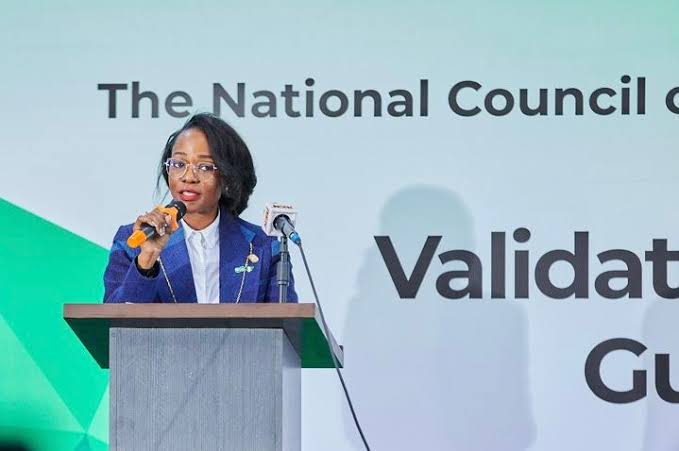
Nigeria will not allow carbon markets that lack integrity or amount to greenwashing, the National Council on Climate Change (NCCC) has warned.
The director-general of the NCCC, Omotenioye Majekodunmi, yesterday at the European Union Climate Dialogue programme organised by the NCCC in partnership with the EU Global Gateway and funded by the European Union.
Majekodunmi, represented by the NCCC director of Energy, Transportation and Infrastructure, Michael Ivenso, said the country was determined to ensure that carbon projects delivered measurable environmental and economic benefits.
He said global carbon markets offered a major opportunity to mobilise private capital for climate action, but warned that the market would collapse without credible systems for verifying carbon credits.
“Global carbon markets present one of the most promising avenues to mobilise this private capital.
“However, as I have repeatedly stated, carbon markets are only as strong as the integrity of the underlying credits.
“A carbon market without rigour is merely an exercise in greenwashing—a scenario that Nigeria will not accommodate,” he said.
Majekodunmi said Nigeria’s carbon projects must deliver “real, additional, and permanent mitigation outcomes” while benefiting communities, protecting ecosystems and ensuring fair returns for investors and project developers.
She said climate finance was critical to powering clean energy transitions, restoring degraded lands, modernising agriculture, improving waste management and expanding access to clean technologies across the country.
The NCCC boss said the operationalisation of Measurement, Reporting and Verification systems was central to building confidence in Nigeria’s emerging carbon market.
“Frameworks on paper do not trade carbon—transparent and verifiable data does. This brings us to the core theme of today’s roundtable: Operationalising Measurement, Reporting, and Verification,” he said.
“MRV is the backbone of market credibility.”
He explained that without credible MRV systems, buyers could not determine whether carbon reductions were genuine, regulators could not properly track emissions, and communities could not ensure fair benefit-sharing.
Majekodunmi disclosed that the government was operationalising a unified national carbon registry to prevent double-counting and ensure the integrity of carbon credits generated in Nigeria.
“Every carbon credit generated, issued, transferred, or retired in Nigeria will carry a digital footprint to prevent double-counting and guarantee baseline integrity,” he said.
He added that Nigeria was moving towards digital MRV using remote sensing, Internet of Things sensors, geospatial data and distributed ledger technologies to reduce verification costs and improve accuracy.
The NCCC identified three immediate regulatory priorities, including finalising carbon market regulations, publishing sector-specific MRV guidelines and establishing local capacity-building hubs for Nigerian auditors and technical experts.
Also speaking, the Director-General of the European Commission’s CLIMA Task Force on International Carbon Pricing and Markets, Jop Watering, said the European Union was prepared to deepen its engagement with Nigeria on high-integrity carbon markets.
Watering said the EU had 20 years of experience with domestic carbon pricing and was now opening its climate strategy to high-quality international carbon credits.
He warned that carbon markets would not succeed if issues surrounding integrity, transparency and accountability were not properly addressed.
“If you don’t get the integrity right, the market will just not take off. It will just not be there,” he said.
Watering said international carbon-crediting mechanisms had so far failed to fully realise their potential because of accounting loopholes and weak checks and balances.
He said the EU wanted stringent methodologies, transparent registries, fair transactions and equitable benefit-sharing to underpin the international carbon market.
The Head of Section, Green and Digital Economy, EU Delegation to Nigeria and ECOWAS, Ms Yolanda Josaid, credible systems were necessary to ensure transparency, accountability and environmental integrity.
She said Nigeria’s National Carbon Market Framework, adopted last year, provided the foundation for domestic and international carbon trading under the Climate Change Act and Article 6 of the Paris Agreement.
The official said a credible carbon market could align Nigeria’s climate targets with development priorities, attract investment and support the country’s transition to a low-carbon economy.
The Director of Forestry at the Federal Ministry of Environment, Halima Bawa Buhari, said Nigeria’s forests remained central to the country’s climate response.
She said forests served as carbon sinks, temperature buffers and sources of livelihoods for millions of Nigerians, particularly rural and forest-dependent communities.
Buhari warned that carbon market development must support forest conservation rather than create incentives for further exploitation.
She called for stronger forest inventories, remote sensing, satellite monitoring and the use of appropriate artificial intelligence technologies to improve carbon measurement.
“Forestry, I’d like to remind us all that the forest sector is central to Nigeria’s climate response because forests are both carbon sinks, temperature buffers, reducing natural disaster risk, livelihoods, humans’ primary food source, and famine, among several others,” she said.
She also called for stronger coordination among institutions responsible for collecting, managing, validating and reporting forest carbon data.
Meanwhile, the UK PACT Officer and Programme Manager at the British Foreign, Commonwealth and Development Office, Folakemi Aletan, said carbon markets could mobilise investment and strengthen Nigeria’s sustainable development.
She said the UK PACT was supporting the NCCC and the Federal Ministry of Environment in developing an MRV platform, strengthening climate transparency and improving emissions reporting.
Aletan said such efforts would boost investor confidence and enable Nigeria to participate more effectively in international carbon markets.
She commended the European Union for bringing development partners and stakeholders together to build a coordinated approach to Nigeria’s carbon market development.
We’ve got the edge. Get real-time reports, breaking scoops, and exclusive angles delivered straight to your phone. Don’t settle for stale news. Join THISTIMES on WhatsApp for 24/7 updates →
Join Our WhatsApp Channel