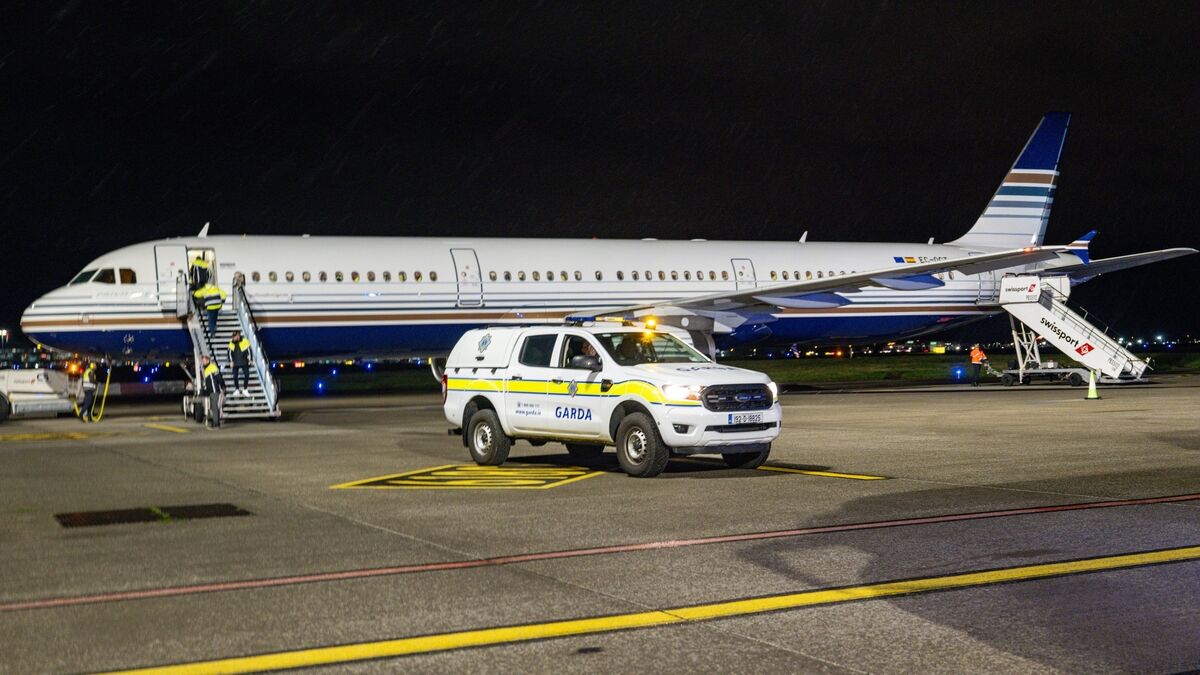
The Irish government has spent nearly €77,000 to deport six Nigerian nationals described as “high risk.”
This is coming after authorities determined they could not safely be removed from the country on commercial flights.
The six men, who had collectively accumulated 75 criminal convictions while living in Ireland, were deported to Rome on a specially chartered aircraft in late July.
From Rome, they joined a joint return operation coordinated by the Italian government and the European Border and Coast Guard Agency, Frontex, to facilitate the removal of people from several European Union member states.
According to a briefing document prepared for Irish Justice Minister Jim O’Callaghan, a risk assessment by the Garda National Immigration Bureau found that several of the Nigerian nationals posed a sufficiently high risk to rule out deportation on ordinary passenger flights.
“After completion of a risk assessment by the Garda National Immigration Bureau in relation to the six deportees, it was concluded that several of them were high risk, and that it was not appropriate for them to be removed from the State on commercial flights,” the document stated.
The briefing said the joint operation provided Ireland with an alternative means of deporting individuals when commercial airlines or standalone charter flights were impractical.
It said commercial airlines permitted only “one deportee per flight”, limiting the number of people Ireland could remove through routine flights.
The Irish government could also lease an aircraft specifically for deportations, but the document noted that “on occasion the numbers on hand may not be sufficient to justify a charter operation”.
Under joint Frontex return operations, Ireland pays for seats on the aircraft, with the cost shared among participating EU member states.
“Ireland will be informed of the cost for the seats once the joint return operation is completed,” the briefing said.
The document said Ireland planned to participate in more Frontex-led flights, adding that the arrangement would help the country deport people to destinations where it would otherwise be difficult to land a dedicated charter aircraft.
“It will enable Ireland to return people to countries that it is difficult for Ireland to land a charter in, or where there are insufficient numbers to run a viable charter,” it added.
The Irish Department of Justice defended the deportations, saying the removal of foreign nationals involved in criminality was a government priority.
“The removal of people involved in criminality, and those who pose a danger to society, is a priority for Ministers O’Callaghan and Brophy,” a department spokesperson said.
The spokesperson confirmed that the charter operation was part of a joint return exercise to Nigeria managed by Frontex and that deportation orders had been enforced against the six Nigerian nationals.
“For the charter cited, which participated in a joint return operation to Nigeria managed by Frontex, deportation orders were enforced against six Nigerian nationals,” the spokesperson said.
The department also disclosed that six charter operations carried out so far in 2026 had resulted in the removal of 221 people from Ireland, including 67 EU citizens deported on grounds of criminality.
We’ve got the edge. Get real-time reports, breaking scoops, and exclusive angles delivered straight to your phone. Don’t settle for stale news. Join THISTIMES on WhatsApp for 24/7 updates →
Join Our WhatsApp Channel