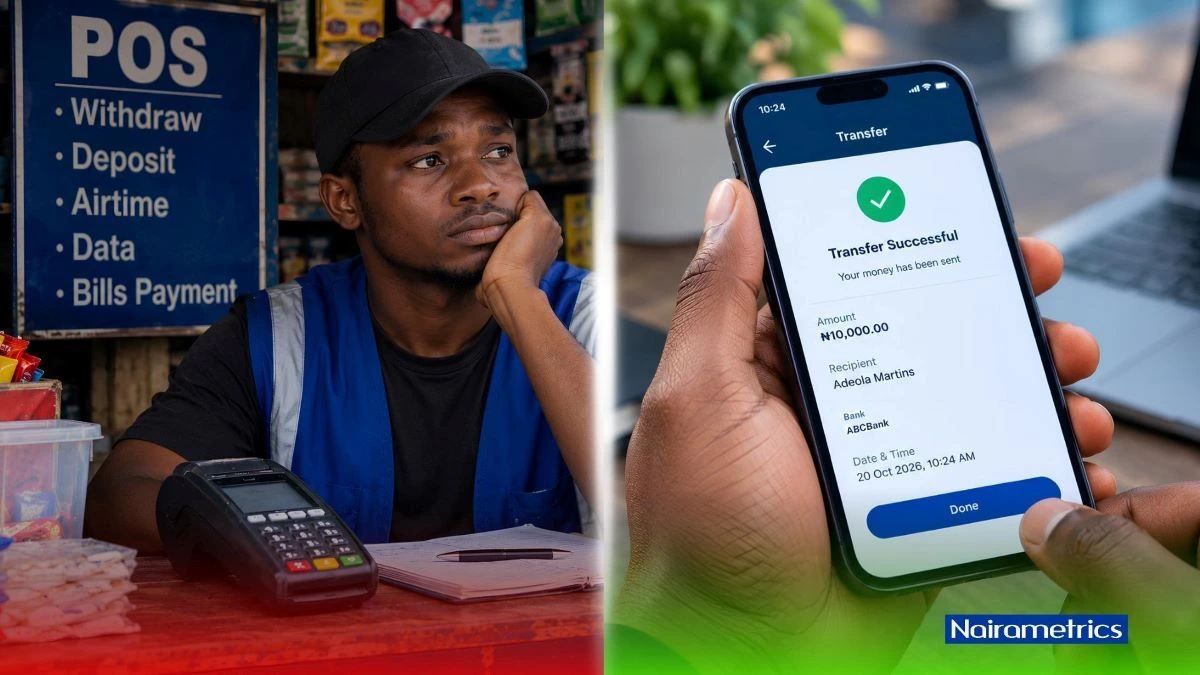
Nigeria’s vast Point-of-Sale (PoS) agency banking network is facing growing pressure as consumers increasingly abandon cash withdrawals in favour of direct mobile transfers, raising concerns about the long-term sustainability of thousands of PoS businesses across the country.
The trend is reinforced by findings from the GSMA’s State of the Industry Report on Mobile Money 2026, which showed that mobile money adoption continues to accelerate worldwide.
According to the report, the number of registered mobile money accounts globally reached 2.3 billion in 2025, while active 30-day accounts rose to 593 million, pushing the global monthly activity rate to 25.7%.
The report also revealed that more than $2.1 trillion flowed through mobile money platforms in 2025, with transaction values growing faster than transaction volumes.
For years, PoS operators filled a critical gap in Nigeria’s financial ecosystem, providing easy access to cash at a time when ATM queues, cash shortages, and banking service disruptions were common.
However, the rapid adoption of mobile banking applications, fintech platforms, and digital wallets is reshaping consumer behaviour, with more Nigerians now choosing to transfer money directly to merchants, traders, transport operators, and service providers rather than withdrawing cash.
The shift reflects the broader transition toward a cashless economy, where transactions increasingly remain within the digital ecosystem.
Nigerians who spoke with Nairametrics said they are more comfortable making mobile transfers for almost every transaction, except on very few occasions when they need cash.
Several PoS agents noted that changing consumer habits are proving even more challenging.
The growing acceptance of mobile transfers among small businesses and informal traders has significantly reduced the need for cash withdrawals, traditionally the backbone of the PoS business model.
Another PoS operator say the decline in cash transactions could be as a result of stricter regulations and growing competition within the sector.
Speaking with Nairametrics, the Lagos-based PoS agent, Bukola, said recent regulatory measures have affected the business.
Operators say many locations that once supported a handful of agents now have dozens of competing businesses serving the same customer base.
CEO and Co-Founder of Sycamore, Babatunde Akin-Moses, told Nairametrics that Nigeria’s rapid shift toward digital bank transfers is driven by a combination of necessity, fintech accessibility, cost efficiency, and network effects.
He recalled that the 2023 cash scarcity initially forced citizens to embrace transfers, transforming an emergency workaround into a long-term consumer habit. Concurrently, fintech platforms made opening and operating accounts significantly easier for informal traders and ordinary citizens, while digital transfers offered a cheaper, more convenient alternative to paying POS withdrawal charges.
According to him, as consumer preference for transfers mounted, a self-reinforcing network effect compelled merchants to adapt, steadily reducing the need to carry physical currency.
He said Nigeria is transitioning into an era where cash functions as a specialized utility rather than the default medium for routine payments.
A fintech expert who does not want his name mentioned because of the organisation he works for said the transition from physical cash channels to mobile transfers mirrors the historical evolution of Nigeria’s telecommunications sector.
Just as consumers shifted from buying paper recharge cards from roadside vendors to seamless digital top-ups, he said financial payments are undergoing a natural channel evolution.
He said at the core of this transformation is user convenience and mutual acceptability, noting that digital transfers eliminate transaction risks, manual input errors, and POS withdrawal surcharges, making direct transfers the increasingly preferred choice.
He, however, noted that despite the rise in mobile transfers, POS agents are unlikely to suffer a significant negative impact due to ongoing cash dependency.
He said rather than becoming obsolete, POS networks are evolving into low-cost distribution hubs for broader financial products, adding that because POS hardware is far cheaper to deploy and maintain than traditional ATMs, financial institutions are actively layering new services onto these last-mile rails—ranging from capital market operations like the Dangote IPO sales via agent networks to future offerings in insurance, pensions, and investments.
According to Nairametrics’ analysis of the Central Bank of Nigeria’s (CBN) Balance of Payments Highlights for the first and second quarters of 2026, Nigeria received $11.12 billion in personal transfers.
It increased from $5.30 billion in the first quarter to $5.82 billion in the second quarter, representing a quarterly rise of $520 million, or 9.8%.
Personal transfers rose to $5.82 billion in Q2 2026 from $5.30 billion in Q1, bringing total inflows for the first six months of the year to $11.12 billion.