Oyo State Governor, Seyi Makinde, has confirmed that discussions are ongoing among opposition leaders over a possible political alliance ahead of the 2027 presidential election, revealing that he is actively involved in efforts to build a coalition capable of challenging the ruling All Progressives Congress (APC).
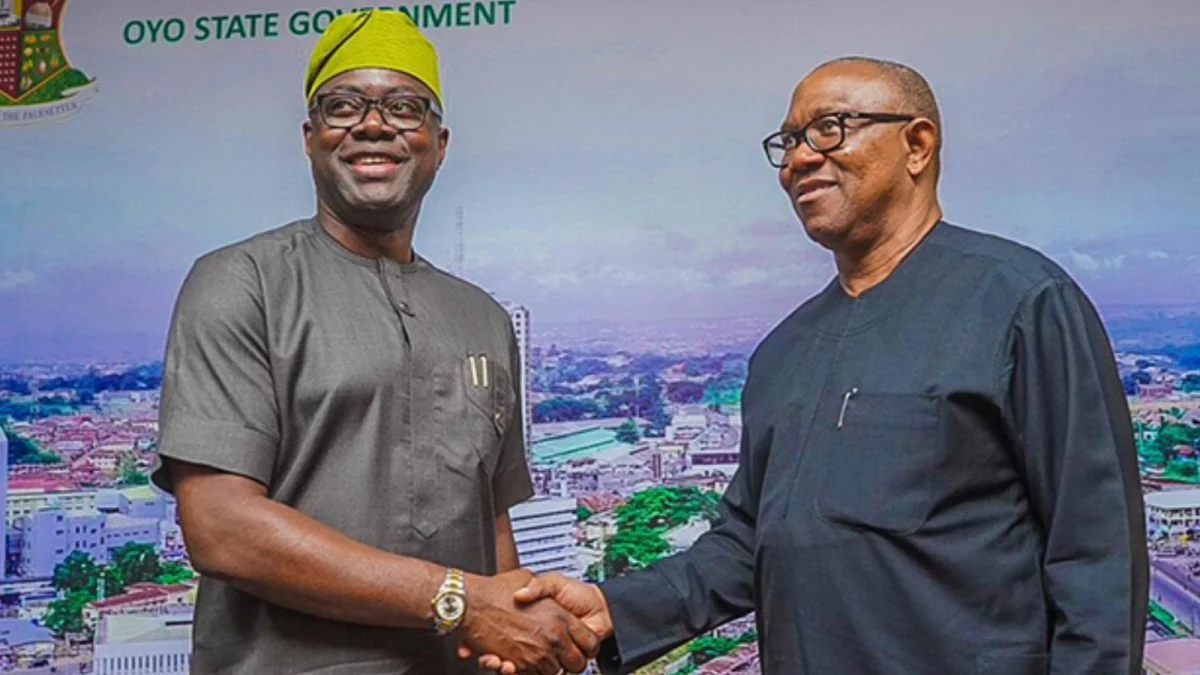
Makinde disclosed that he was willing to work with former Vice President Atiku Abubakar and former Labour Party presidential candidate Peter Obi as part of efforts to achieve what he described as resetting Nigeria.
The governor made the disclosure during an interview with ARISE News anchor, Ojy Okpe, where he spoke about the possibility of opposition politicians putting their differences aside to establish a common political arrangement before the next general election.
According to him, discussions are already taking place, contrary to suggestions that he was only expressing interest in a possible alliance.
“We’re still discussing,” Makinde said.
When asked whether he was open to working with other prominent opposition figures, including Atiku and Obi, the governor made it clear that the process had gone beyond preliminary considerations.
“Not only that I’m open, we’re actively discussing this.”
However, Makinde avoided declaring support for either Atiku or Obi as his preferred presidential candidate.
He maintained that the opposition must carefully examine available information before deciding who should emerge as the candidate around whom other political forces would unite.
He argued that the decision should not be based on personal relationships, political sentiments or emotional attachment to any individual.
Instead, he said the process must involve a proper assessment of the candidates, their political records, policy proposals and public acceptance.
“To arrive at a decision, you need data,” he said.
The governor explained that opposition leaders would have to study the manifestos presented by the different political actors and compare their previous performances before reaching an agreement.
He said public opinion would also play an important role in determining the direction of the proposed arrangement.
“We just won’t say, ‘Oh, okay,’ take emotional decision and say, ‘Oh, it’s you.’ We have manifestos now, we have certain things in that manifesto.
“We will sit down, we have maybe historical performance. We also have the sentiment of the people. All of those things will come together and arrive at a decision.”
Makinde further explained that political competition did not necessarily prevent individuals or organisations from working together when circumstances required cooperation.
Drawing from his experience in the oil and gas industry, the governor said companies operating in the same sector could maintain competing interests while also entering into partnerships when there was a common objective.
He used the example to explain how opposition politicians could find themselves in different political positions depending on the outcome of their negotiations.
According to him, the eventual arrangement could see some individuals become political allies, while others might take different roles within the same political structure.
“Depending on what we see between now and the election time, we may be rivals, we may be collaborators, we may be — one may be the client of the other,” he said.
During the interview, Okpe also asked whether Makinde was prepared to cooperate with other opposition leaders in pursuit of his campaign to reset Nigeria.
The governor responded in the affirmative, insisting that his position was not restricted to any particular politician or political group.
“To reset Nigeria, yes.”
He was subsequently asked whether he would be willing to support Atiku if consultations and available data established that the former vice president was the most suitable candidate to lead the opposition into the 2027 presidential election.
Makinde answered, “Yes.”
He further stated, “I’m willing to work with any Nigerian.”
Makinde also referred to Nigeria’s political history to explain why opposition leaders must look beyond regional popularity when making decisions about presidential elections.
He cited the 1999 presidential election, when Olu Falae enjoyed considerable support in the South-West but could not translate that backing into victory at the national level.
Falae contested the election against Olusegun Obasanjo, who eventually emerged as president.
Makinde maintained that the first responsibility of opposition politicians should be reaching an agreement on the most appropriate political direction before proceeding with the process of forming an alliance.
“Our biggest challenge is, first, to agree on what is the best course of action, and then seek an alliance,” he said.
The Oyo governor also mentioned South Africa’s political experience, where competing political interests have entered into negotiations and cooperation arrangements when faced with circumstances requiring a broader political understanding.
He argued that Nigeria’s opposition leaders should approach their discussions with similar flexibility and avoid allowing individual ambitions to undermine the possibility of a united front.
Makinde particularly stressed that the negotiations must not become an opportunity for politicians to pursue personal interests or secure positions for themselves.
He said the discussions should focus on reaching an agreement that addresses the country’s challenges and provides a common direction for the opposition.
“That negotiation will not be anything personal,” Makinde said. “That negotiation will be the deal for Nigeria, by Nigeria.”