The passage of the State Police Bill by the red chamber of the National Assembly on Wednesday did not send shockwaves through the country. Even before the Senate President, Godswill Akpabio, read out the letter from President Bola Ahmed Tinubu on the bill for the Senate to deliberate on, there seemed to have been a consensus on the need for a speedy passage of the bill that many, including yours sincerely, believe could provide answers to the present wave of insecurity. When political will is abundant, no solution can be unsolvable. Considering the urgency of establishing the State Police to rein in the activities of criminals and terrorists, the hope that the battle is set to take on a new dimension requires the collaboration of critical stakeholders.
Overcoming Reality
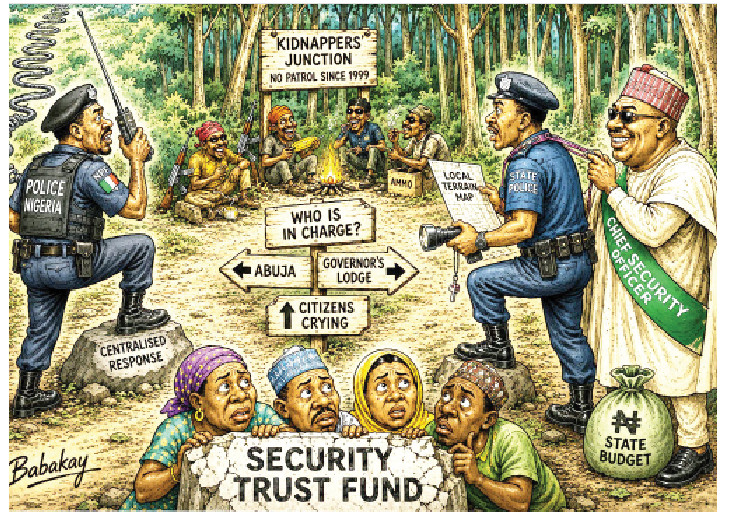
The quest to create a State Police is not a recent demand. Governors, who have long partnered with the Nigerian Police Force (NPF), have been at the forefront of this demand. Hundreds of billions of naira have been doled out by some state governors, often described as Chief Security Officers, to assist the NPF and other security agencies in overcoming the firepower of criminal groups. In words, these governors may only answer the title, but they’re powerless as worms when the urgency to play that role arises.
Deployment of security personnel may be unrealisable due to the absence of a response from Abuja. By the time security personnel are ordered to the crime scene, it is often too late. The need to effectively take charge of their domains and strengthen governors’ resolve to deal with these criminals remains the primary driver behind the establishment of the State Police.
Ahead of the formal establishment of the State Police, now fewer than 11 states of Borno, Adamawa, Katsina, and Kaduna have gone ahead and created Forest Guards. If the state police outfit is eventually created, the Senate must work out modalities between the state and federal police. If the Forest Guards are to be federally owned, the State Police must be clearly streamlined to avoid clashes. However, since the current attempt to create state policing aims to return security power to the state, as it was during the First Republic, the state’s security, including its forests, must come under the watch of the state governors.
Recurring Fears
Fears have been expressed in some quarters about the creation of the State Police. Chief among them is the possibility that governors may deploy the soon-to-be-created outfit as a tool to deal with political opponents. The fears over ethnicisation and subjecting the outfit to some religious sentiments on state policing are still a subject of a raging debate.
In a country where everything is interpreted through the lens of religion and ethnicity, especially in the North, these fears cannot be easily dismissed with a wave of the hand. Much as state governors should be allowed to exercise their power to secure the lives of their citizens through state policing, the need to place safeguards to prevent some governors from exceeding their duties should not be left unaddressed.
I have not gone through the details of the State Police bill passed by the Senate, but I am optimistic, like many others, that sufficient safeguards have been included to prevent governors from seizing the state police for political purposes. I have had cause to warn against the hasty passage of the bill without public hearings. Now that the bill has been passed, I pray the electorate may not be saddled with the task of expunging certain sections to improve the State Police when operational.
Clinging To Hope
There are still discordant rumblings over the prospects of the State Police as a platform for addressing insecurity. However, despite the fears, many citizens have pointed to the clear advantage of state policing as bringing security management closer to the people. To avoid the present situation in which security agencies were outside governors’ control, state policing aims to enable governors to truly assume their responsibilities as Chief Security Officers of their respective states.
There is growing confidence in the State Police’s ability to address insecurity, but many hurdles must be overcome to ensure its successful operation when it is eventually created. Without a doubt, the North carries the burden of insecurity in the country, except for the South-east-linked separatist movement of the Independent Peoples of Biafra (IPOB), which is linked to the activities of a criminal Fulani group. Northern governors must think outside the box to arrest the monsters of insecurity.
The growing discontent in the South-west and the threat of the ‘Yoruba freedom fighter’, Sunday Igboho, to deal with the abductors of school students and teachers in Oyo State speak to the urgency of creating a state policing platform. It must be stressed here that some of the security challenges ripping through some parts of the country remain insurmountable due to a conspiratorial crisis that suggests those mandated to defeat insecurity are also involved in frustrating the fight against it. For the State Police to succeed, Nigeria must defeat rogue elements in its security forces that have continued to collaborate with non-state actors at war with the nation.
For the State Police to be a lethal weapon against insecurity, it must be insulated from ethno-religious and political sentiments that have been turned into a staircase for dividing Nigerians and a tool for political upliftment by some rogue politicians. If the concept of State Police is to be successful, it must serve as a prologue to a larger restructuring of the Nigerian State, in which the issue of security is democratised from the ward level to the national level. Only through the State Police, with the active engagement of the attacked communities, can a final blow be dealt against the forces of insecurity.
We’ve got the edge. Get real-time reports, breaking scoops, and exclusive angles delivered straight to your phone. Don’t settle for stale news. Join THISTIMES on WhatsApp for 24/7 updates →
Join Our WhatsApp Channel