The African Democratic Congress (ADC) has disclosed that it was represented at the signing of the 2027 National Peace Accord in Abuja despite the absence of its presidential candidate, Atiku Abubakar.
According to the opposition party, its National Legal Adviser, H.E. Professor Oserheimen Osunbor, attended the event on its behalf and represented the ADC during the signing of the agreement.
The ADC disclosed this in a social media post while clarifying its participation in the peace accord ahead of the commencement of campaigns for the 2027 presidential and National Assembly elections.
“Yesterday, our National Legal Adviser, H.E. Professor Oserheimen Osunbor, represented our great party, ADC, at the signing of the National Peace Accord in Abuja,” the party said.
Atiku, a former Vice President and the ADC presidential candidate, was among the presidential candidates expected at the event but did not attend physically. He was one of the candidates represented at the ceremony.
The peace accord was signed in Abuja on Tuesday by President Bola Tinubu and 16 other presidential candidates as political parties prepared to begin full campaigns for the 2027 elections.
It was organised by the National Peace Committee, led by former Head of State Abdulsalami Abubakar, in collaboration with The Kukah Centre. It was held a day before the official commencement of campaigns for the presidential and National Assembly elections.
The accord commits political parties and their candidates to peaceful and issue-based campaigns while rejecting violence, hate speech, misinformation and the use of artificial intelligence to spread disinformation.
Aside from Atiku, President Tinubu was also not physically present at the ceremony. He was represented by the Secretary to the Government of the Federation, George Akume, who delivered the President’s message to the political parties and candidates.
Tinubu urged politicians to place the interest of Nigeria above personal and partisan ambitions as the campaign season begins.
“Let us campaign on superior ideas. Let us debate issues and promote the best policies to expand opportunities for our people,” he said.
The President also warned political actors against using ethnic and religious sentiments to gain electoral advantage, while stressing that the 2027 election should not be treated as a battle in which only one side can emerge.
“Elections are not a do-or-die affair. We are partners in the project of nation-building. Win or lose, our country, Nigeria, must be the ultimate winner,” Tinubu said.
The National Peace Accord comes against the background of Nigeria’s history of election-related violence, intimidation, inflammatory rhetoric and disputes. Since the return to democratic rule in 1999, several elections have been marred by violence, with the 2011 general elections witnessing deadly clashes in different parts of the country.
The National Peace Committee has facilitated similar agreements since 2015, using them as a platform to encourage candidates and political parties to avoid violence and personal attacks and instead campaign around policies and programmes.
The 2027 ceremony attracted several presidential candidates, including Peter Obi of the Nigeria Democratic Congress (NDC), Adewale Adebayo of the Social Democratic Party (SDP), Donald Duke of the Peoples Redemption Party (PRP), Chibuzor Okereke of the Labour Party (LP) and Omoyele Sowore of the African Action Congress (AAC).
Other political figures present included APC National Chairman Nentawe Yilwatda, Deputy Senate President Barau Jibrin and PRP National Chairman Hakeem Baba-Ahmed.
The Independent National Electoral Commission (INEC) Chairman, Joash Amupitan, said the peace accord should go beyond being a ceremonial document and serve as a guide for political behaviour throughout the election period.
“Electoral contests in a constitutional democracy are not total wars; they are competitive job interviews before the electorate. Nigerians do not want insults; they want solutions,” Amupitan said.
He warned politicians against hate speech, organised misinformation, premature claims of victory and the misuse of social media and other digital platforms. He also highlighted the growing challenge posed by artificial intelligence in the spread of false information during elections.
Amupitan said INEC was preparing to deploy about 1.4 million ad-hoc personnel to more than 176,000 polling units for the 2027 elections.
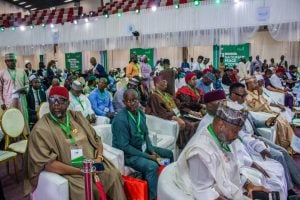
Obi, the NDC presidential candidate, questioned why politicians should need a formal agreement before respecting the principles of peaceful elections. He also called on Nigerians to reject candidates who violate the commitments contained in the accord.
“Can we have an election where people’s vote will count?” Obi asked.
Sowore, meanwhile, argued that peace would be difficult to sustain without justice and accountability. He called for what he described as a “Justice Accord” to complement the existing peace agreement.
The Nigeria Police also pledged to provide security during the electoral process. The force was represented at the ceremony by Deputy Inspector-General Umar Shehu, who assured Nigerians that security agencies would work to enable voters to exercise their rights without fear.
The presidential and National Assembly elections are scheduled for January 16, 2027, while the governorship and State Assembly elections will take place on February 6.