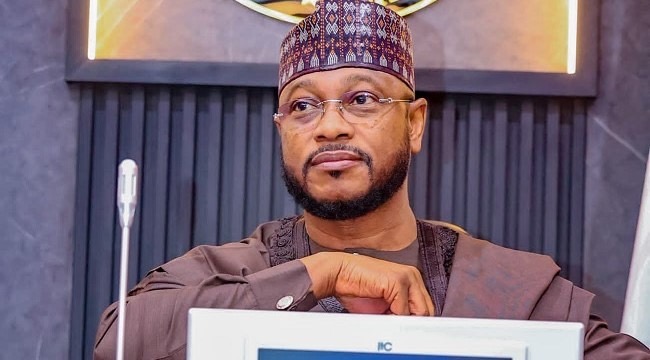
Spokesperson for the 2027 presidential campaign of former Vice-President Atiku Abubakar, Kenneth Okonkwo, has said President Bola Tinubu misconstrued the petrol subsidy policy recently proposed by the African Democratic Congress (ADC) presidential candidate.
The actor-turned-politician spoke on Channels Television’s programme, where he dismissed insinuations that Atiku was planning to return Nigeria to the “corruption-ridden” subsidy regime of the past.
On Wednesday, Atiku had said he would restore petrol subsidy if elected president in 2027.
Atiku, who spoke in Hausa during an interview with an ADC media group, also accused the Tinubu administration of failing to account for funds saved from the removal of the petrol subsidy.
The comment sparked widespread reactions on social media, with critics arguing that it contradicted the policy manifesto Atiku presented ahead of the 2023 elections, in which he reportedly promised to remove the petrol subsidy if elected.
Reacting, Tinubu said Atiku’s proposal showed “serious ignorance of governance and economy,” noting that before he assumed office, some states struggled to pay salaries and pensions.
However, Okonkwo condemned the President’s remarks, insisting that Atiku’s proposal was a well-thought-out plan to make petrol affordable for Nigerians.
“The whole idea of the Atiku plan is affordability of fuel to the ordinary Nigerian,” he said.
“It is ignorance of Tinubu to say that Atiku wants to go back to the subsidy of the old. If ignorance should have another name, that name would have been called Tinubu.”
Okonkwo also referenced the controversy surrounding the alleged fake Presidential Foreign Intervention Promotion Council (PFIPC) under the current administration as evidence of what he described as the President’s “ignorance”.
“Tinubu is a man who drafted a budget and, in his own budget, he made provision for an agency that he said is fake, which, under his nose, is even ignorant of the agencies that he has,” he said.
“If ignorance was to be a name, Tinubu is the president.”
Okonkwo argued that there would have been no need for petrol subsidy in Nigeria in the first place if successive governments had ensured adequate fuel supply and eliminated monopoly in the sector.
“This is what Atiku is saying. And I’m going into the Atiku plan, which we call Atiku Fuel Affordability Plan (AFAP),” he said.
According to him, Atiku’s proposal does not seek a return to the old subsidy regime, which he said was characterised by fuel imports and corruption.
“This was the way the subsidy of the old operated. They were importing 100 per cent of the fuel,” he said.
“We didn’t have any refinery. Atiku and Obasanjo sold the refineries off, saying the government, from what they have experienced, cannot handle the refineries.
“But they reversed the policy. So, they were importing 100 per cent of the fuel. And in the importation, when they import 40 million litres, they will say it’s 60 million litres; it is inflated. Nigerians will be paying for 20 million litres.
“And if they imported it at $1, they would say it’s $2. So, you will be paying an extra $1. Corruption. And that was how subsidy became synonymous with corruption. Atiku is not going back to that and cannot even go back to that.”
Okonkwo said the return of local refineries meant Atiku’s plan would instead focus on making petrol affordable by ensuring that the facilities had access to crude oil at a fair price.
According to him, the ADC presidential candidate believes the Tinubu administration has failed to make petrol affordable despite the operation of local refineries.
“He said, I will supply the needed crude to our local refineries at a price that will be fair enough for them to use to produce the fuel at a reduced and affordable price to Nigerians,” Okonkwo said.
He also accused the current administration of failing to supply adequate crude oil to the Dangote Refinery, saying this had contributed to the facility’s high production cost.
“I once said that even if Dangote Refinery came into existence, they will not give us fuel at a cheap rate in Tinubu’s regime,” Okonkwo said.
“What we are suffering today is not demand-pull inflation. It’s cost-of-production-induced inflation, meaning even if the demand is zero, the price will still be high because the cost of production is very high.
“Dangote is importing the crude oil that it is using to produce oil.”
We’ve got the edge. Get real-time reports, breaking scoops, and exclusive angles delivered straight to your phone. Don’t settle for stale news. Join THISTIMES on WhatsApp for 24/7 updates →
Join Our WhatsApp Channel