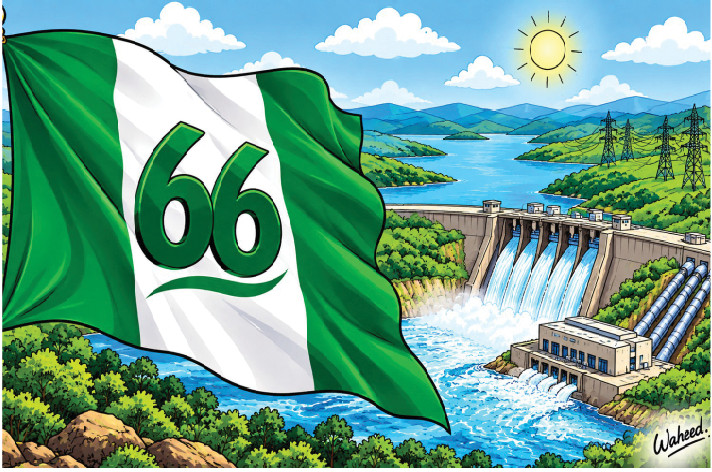
On October 1, Nigeria will once again raise the flag, sing the anthem and celebrate 66 years of independence.
There will be speeches about resilience, unity, progress and the promise of a better tomorrow. There will be reflections on where we have been, where we are and where we hope to go. But perhaps, this year, there is another reason to pause. Nigeria has just dodged a very expensive bullet: the long-running dispute between Sunrise Power and Transmission Company Limited, promoted by Leno Adesanya, and the Federal Government of Nigeria over the Mambilla Hydropower Project.
On September 17, an International Chamber of Commerce tribunal in Paris delivered its final award in favour of Nigeria, rejecting claims that could have exposed the country to liabilities running into billions of dollars
Nigeria should be relieved. But we should also be reflective because the Mambilla saga is not simply a story about an arbitration victory. It is a story about governance, public contracting, institutional authority and the enormous price a country can pay when those things go wrong.
At 66, perhaps that is the Independence Day lesson we need.
A $3 Billion Bullet
The figures alone should make every Nigerian sit up.
Sunrise’s original arbitration, commenced in 2017, sought about $2.354 billion over an alleged breach of a 2003 agreement concerning the development of Mambilla. A separate claim arising from a later settlement arrangement sought another $400 million. The Federal Government says the wider claims, including interest, exceeded $3 billion.
Three billion dollars is not an abstract figure in Nigeria. It is money that could fund thousands of classrooms, equip hospitals, build roads and water infrastructure, or support electricity development in a country where businesses and households continue to struggle with unreliable power.
And this was not a liability arising from a functioning multibillion-dollar power plant producing electricity for Nigerians. It arose from a project that has remained unfinished for decades.
The tribunal’s decision has therefore spared Nigeria an extraordinary financial burden. It also ordered Sunrise and Adesanya to reimburse Nigeria 75 per cent of its legal fees and expenses, reportedly about $11.82 million.
For a country accustomed to losing public money through bad contracts, abandoned projects and poorly managed disputes, this is significant. But the more uncomfortable question is: how did Nigeria get here in the first place?
When Does A Government Contract Bind Nigeria?
The story goes back to 2003.
Then Minister of Power and Steel, Olu Agunloye, issued a letter concerning the award of a build-operate-transfer contract for Mambilla to Sunrise. The project was reportedly valued at about $6 billion. That authority later became one of the central fault lines in the dispute.
Former President Olusegun Obasanjo maintained that he had not authorised the contract and that he had directed that the proposal be withdrawn before it was presented to the Federal Executive Council.
Sunrise, however, relied on the ministerial communication as evidence of the government’s commitment. That disagreement captures one of the most dangerous weaknesses in public administration: uncertainty about who has the authority to bind the state.
A minister cannot simply create a multibillion-dollar obligation for the Federal Republic without the requisite approvals. Equally, a private investor entering into an agreement with government should not have to discover years later that the official who signed it may not have had the authority to do so.
Prebendalism At Its Finest or Worst?
Perhaps the most troubling chapter came much later when public office became a private opportunity.
By 2020, the then Attorney-General of the Federation and Minister of Justice, Abubakar Malami, had become involved in efforts to resolve the longstanding dispute. A settlement was reached under which Nigeria was to pay Sunrise $200 million. An addendum subsequently exposed the country to another $200 million in default liability, potentially taking the exposure to $400 million, apart from interest.
This is where Malami and Adesanya become central to the story. Adesanya was the promoter of Sunrise, the private party pursuing claims against Nigeria. Malami was Nigeria’s chief law officer, charged with protecting the legal interests of the Federal Republic. Yet the ICC tribunal found that the two had an “inappropriate relationship” and concluded, on the evidence before it, that they reached a corrupt deal connected to the settlement. It further found that Malami had acted against Nigeria’s interests and was motivated by other incentives.
However, Malami has rejected the tribunal’s corruption finding. He maintains that he acted in Nigeria’s interest to resolve a longstanding dispute and has argued that the tribunal’s findings should not be presented as a criminal conviction. But the finding remains part of the tribunal’s final award and cannot simply be wished away.
The wider award also examined a pattern of payments and financial dealings involving Adesanya and people connected to several former public officials. The tribunal was careful not to treat every questionable transaction as proven bribery. That distinction matters. But its findings concerning the Malami-Adesanya settlement were considerably more direct. This is what makes the Mambilla saga so disturbing.
A project intended to generate electricity became entangled in questions about contracts, influence, payments, settlements and competing interests. And ultimately, it was the Nigerian taxpayer who stood to carry the bill.
At 66, Sovereignty Must Mean More Than Independence
This is where Mambilla meets October 1.
Independence is ultimately about sovereignty. But sovereignty is not merely about having a national flag, a national anthem and a seat at the United Nations. It is also about having institutions capable of exercising public authority responsibly.
A sovereign state should know who can commit it, what contracts it has signed, what it owes and should not discover decades later that a document signed in its name may expose generations of citizens to billions of dollars in liability.
There is another remarkable detail in this story. The tribunal found that the 2020 settlement and its addendum were not binding on Nigeria because they lacked the necessary presidential approval. Former President Muhammadu Buhari had rejected the proposed settlement, including with a handwritten “Not approved” on a later request.
Imagine the implications. An agreement potentially exposing Nigeria to hundreds of millions of dollars was negotiated, but the required presidential approval was not obtained. That is not merely a legal technicality. That is a governance problem.
Nigeria’s 66th year therefore offers an interesting paradox. We are celebrating independence while confronting a case that demonstrates how institutional weaknesses can undermine the practical meaning of sovereignty.
The good news is that Nigeria won this round. The better news would be if we learn from it. The Mambilla project itself now stands at another important threshold. The Federal Government has described the ICC decision as removing the biggest legal obstacle to the project’s progress. That opportunity must be approached with extraordinary care. Nigeria cannot afford to replace one Mambilla dispute with another.
Every future commitment must have an unmistakable legal foundation, a clear approval trail and appropriate institutional and legal processes. Contract records must survive administrations and officials must understand that public authority is not personal authority.
As we celebrate 66 years of independence, perhaps the more meaningful aspiration is not merely a country that survives its crises, wins its court cases and escapes its liabilities, but a country whose institutions are strong enough to prevent avoidable crises from becoming national emergencies.
At 66, Nigeria deserves more than resilience.
We’ve got the edge. Get real-time reports, breaking scoops, and exclusive angles delivered straight to your phone. Don’t settle for stale news. Join THISTIMES on WhatsApp for 24/7 updates →
Join Our WhatsApp Channel