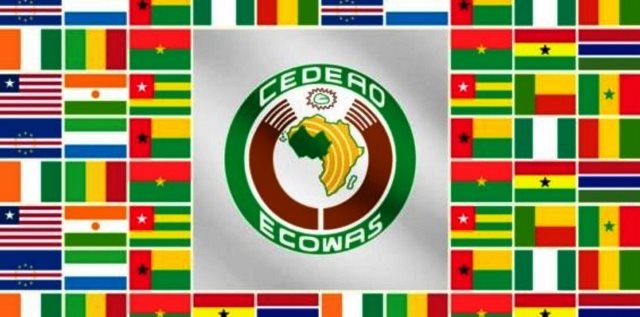
The Nigerian permanent representative to the Economic Community of West Africa (ECOWAS), Ambassador Emmanuel Olawale, has urged governments in the region to create a favourable environment for the body’s programmes, projects and activities to thrive in their countries.
This is just as the High Commissioner of the Republic of Sierra Leone to Nigeria/permanent representative to ECOWAS, Julius Sandy, stressed the need to build a West Africa where borders connect rather than divide, and where citizens can travel with dignity across member states.
They spoke at the public presentation of a book titled, “In Solidarity with ECOWAS,” written by the executive director of the Citizens Participation Against Corruption Initiative (CPAC — I), Bishir Dauda Katsina, in Abuja, yesterday.
Represented by Joseph Igwe, the Nigerian permanent representative to ECOWAS, identified the efforts being made by the regional body to ensure cooperation among West African Countries.
He said one of such is the protocol on free movement, residence and establishment, which makes it possible for individuals and community members to move around and enter any ECOWAS country.
“For instance, if you look at our passport, it is written ECOWAS Passport. There is also the ECOWAS Paraplegic Identity Card. All those things are to support the social movement.
“ECOWAS has also brought in some other facilities, like the road network. In practical terms, what comes to mind in this case is the Lagos-Abidjan Corridor. The Lagos-Abidjan Corridor that runs from Lagos, Benin Republic, Togo, and Ghana to Abidjan. It is one of the ECOWAS roads currently under construction.
“There is also this ECOWAS Coastal Road, and you will agree with me now with the composition of ECOWAS at present, all the present ECOWAS members, currently, they all have borders in the water,” Olawale said.
He acknowledged the challenges facing the region, such as language barriers, and called for the inclusion of French in the curricula of schools in English-speaking countries in West Africa, and vice versa.
“If you look at Nigeria, we are surrounded by French-speaking countries, and we only speak English. So it is necessary that we begin teaching our children French so that the integration effort will sink in deeply among our students and the population.
“Other challenges might be the activities of border authorities and currency. These are difficulties, but ECOWAS is not oblivious to this. Of course, it has introduced the ECOWAS single currency, which aims to use ‘ECO’ as the single currency for all of West Africa.
“So, ECOWAS is making efforts. We only urge our national governments to provide conditions favourable for the ECOWAS programmes, activities and projects to thrive in our countries,” Olawale added.
In his submission, the Sierra Leonean Permanent Representative to ECOWAS said the freedom of West Africans to move, connect and trade across the region is no longer a distant aspiration but a development imperative.
“As the region grapples with mass human movement driven by environmental disasters, conflict, and Funding and Institutional Weaknesses
“The operations of ECOWAS are largely hindered by financial constraints. Most Member States are in arrears of Community Levy Payments. At the moment, ECOWAS is reportedly in arrears of circa $870 million.
“Prohibitive travel cost- a 6-hour flight from Abuja to London costs less than a usual 3-hour flight from Abuja to Freetown.
“Lack of political will, political instability, inter-state border disputes, intra-state insurgencies, and the reluctance of Member States to surrender national sovereignty to a sub-regional organ undermine the idea of a borderless,” he stated.
Sandy called for digitalisation and modernised border management, institutional security and democratic consolidation, the deepening of people-to-people diplomacy, public awareness, citizen engagement, and partnerships.
“If we truly want to build the West Africa that works for all, we must build a West Africa where borders connect rather than divide; where ECOWAS citizens can travel with dignity across Member States; where mobility is safe, orderly, and productive and where movement drives prosperity, innovation, solidarity, and peace.
“The vision of a borderless West Africa is deeply rooted in the conviction of the founding fathers of ECOWAS – that borders should serve as bridges of cooperation, not barriers to opportunity; as channels of exchange, not walls of exclusion; and as instruments of integration, not obstacles to our shared prosperity,” he added.
For his part, the author of the book, Dauda, said the work originated from the journey he had embarked on in 2025 to 10 West African countries to celebrate the Golden Jubilee of ECOWAS.
He said the aim was to raise awareness of ECOWAS’s impact across the continent, particularly in peace, security, democracy, and economic and regional integration.
“So I think that is the reason why I embarked on that trip, and when I returned, then I started writing the book. The travelling experience reinforced my belief that ECOWAS has made a significant impact in the areas I mentioned earlier.
“Take, for example, we’re talking about promoting unity and integration in West Africa. So, in most of the countries I visited, I discovered barriers, but there was intermingling among nationals from different West African countries.
“I was in the Benin Republic. I visited a settlement of immigrants, mostly Hausa people from northern Nigeria and the southern part of the Niger Republic. I saw them living peacefully, coexisting with other nationals of other countries. There was no discrimination; they were not facing any discrimination. So, all the countries that I visited, I saw that kind of intermingling and interaction.
“The book covers a lot of issues. Including identity politics. In Nigeria, especially in the central part, they talk about indigenes, citizens, and settlers. If you go to Ghana, there is nothing like the indigenous people. If you go to Ghana, the Hausas speak to us as citizens of Ghana. They are not to be discriminated against or labelled as immigrants or non-indigenes.
“…In my book, I have mentioned that insecurity is one of the challenges facing ECOWAS member states, even though we all know that there is what is known as a collective security mechanism,” he added.
We’ve got the edge. Get real-time reports, breaking scoops, and exclusive angles delivered straight to your phone. Don’t settle for stale news. Join THISTIMES on WhatsApp for 24/7 updates →
Join Our WhatsApp Channel