The Trade Union Congress of Nigeria (TUC) has demanded that the federal government substantially increase funding for security operations and take urgent steps to strengthen the naira.
The labour centre argued that insecurity and exchange-rate pressures continue to undermine investment, food production and workers’ living standards.
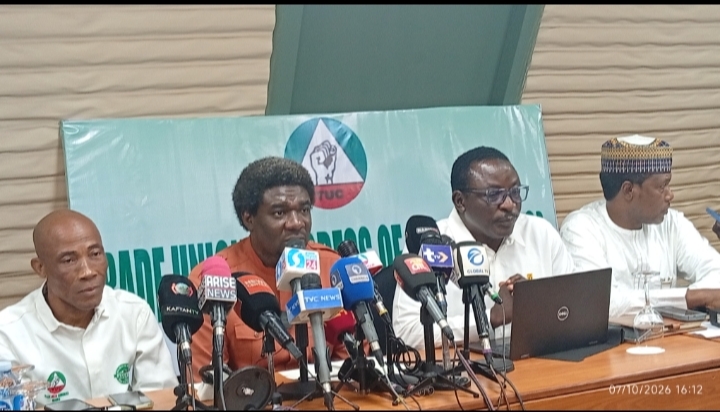
TUC president-general, Comrade Festus Osifo, who spoke on Wednesday in Abuja after the congress’s national administrative council meeting in Abuja said the council reviewed security, economic and labour-related issues affecting workers and the wider society.
Osifo commended the Director-General of the Department of State Services (DSS) and the national security adviser for their efforts in tackling insecurity, particularly recent arrests and convictions of suspected terrorists and kidnappers.
He, however, said the continued spate of kidnappings and killings in parts of Plateau, Zamfara, Borno, Katsina, Niger and other states showed that the government needed to intensify its response.
According to him, insecurity has discouraged farmers from returning to their farms in affected communities, while the wider uncertainty has made Nigeria less attractive to both local and foreign investors.
He urged the government to consider reallocating funds through budgetary measures to provide security agencies with the equipment and resources required to decisively confront insurgency and banditry.
He said, “We have proposed at a time as Trade Union Congress of Nigeria that government should even carry out what we call virement budget to move funds to that area to procure the necessary equipment, to procure all the necessary gadgets, to wipe out these people once and for all.”
Osifo also called for accountability over the deaths of about 37 miners in the custody of the Nigeria Security and Civil Defence Corps in Niger State, describing the incident as unacceptable and urging the government to act on the findings of the committee set up to investigate the deaths.
He said the report should not be allowed to gather dust, insisting that anyone found culpable, regardless of status, should be punished in accordance with the law.
He said, “We don’t want the committee report to just be another report that is going to be gathering dust on the shelf. When the committee submits their report, we want the government to act, and act decisively. Whoever is culpable, no matter how highly placed, must be decisively dealt with according to the letters and the spirit of a law.”
On the economy, the TUC leader acknowledged signs of improvement in inflation and the foreign exchange market but argued that the naira remained undervalued.
He commended the governor of the Central Bank of Nigeria, Olayemi Cardoso, for what he described as progress in stabilising the currency, but said the naira should ultimately trade at between N700 and N800 to the dollar.
Osifo argued that a stronger naira would reduce the cost of imported inputs, including fertiliser, energy and other goods with significant foreign-exchange components, while easing pressure on consumers.
He said the benefits of currency depreciation had been unevenly distributed, with the cost of infrastructure contracts and imported equipment reflecting exchange-rate movements while workers’ earnings had not risen at a comparable pace.
“We still believe that Naira should be somewhere between 700 to 800 Naira to USD. Currently, our naira is undervalued our naira is not trading at the strength it should. Today, at 1,300, it’s still undervalued. So government should do everything possible to move the Naira to the right value.
The cost of literally everything today is high because of the exchange rate. So we think that when the CBN could successfully manage it to where it should be, it will reduce the pressure that we face as a people and as a nation”, he added.
The TUC president-general also urged the Independent National Electoral Commission (INEC) to ensure that preparations for the 2027 general elections remained transparent, inclusive and credible.
He said only leaders genuinely elected by the electorate could be expected to remain accountable to the people rather than to political godfathers and financiers.
On labour issues, Osifo warned that the two labour centres could be forced to take further action if outstanding issues arising from the communiqué that suspended the Joint Health Sector Unions (JOHESU) strike remained unresolved.
He called on the minister of health, Prof Muhammad Ali Pate, to intervene urgently and ensure that the agreements reached with the unions were implemented.
The TUC also raised concerns over the crisis in Nigeria’s textile industry, citing high energy and production costs, layoffs and declining purchasing power among consumers.
Osifo urged the federal, state and local governments to support the revival of the sector, noting that the industry had historically provided employment for millions of Nigerians.
On the controversy surrounding the concession of King’s College, Lagos, he said the TUC had contributed to a seven-member committee established to address the dispute and urged all parties to work towards a solution that would protect the interests of workers, parents, old students and government.
We’ve got the edge. Get real-time reports, breaking scoops, and exclusive angles delivered straight to your phone. Don’t settle for stale news. Join THISTIMES on WhatsApp for 24/7 updates →
Join Our WhatsApp Channel