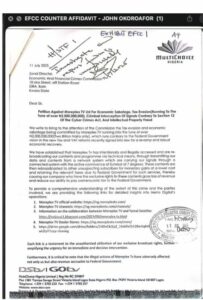
MultiChoice Nigeria Limited, operator of DStv and GOtv, has petitioned the Economic and Financial Crimes Commission (EFCC) over alleged economic sabotage, tax evasion and unlawful interception of broadcast signals by indigenous pay-TV operator, Moreplex TV.
The petition has escalated an already contentious dispute between the two companies, which have been involved in a long-running civil and commercial disagreement over access to television channels, content rights and alleged exclusivity in Nigeria’s pay-TV market.
The two-page petition, addressed to the Zonal Director of the EFCC in Ilorin, Kwara State, was signed by Umar Ibrahim Abdulaziz, Head, Anti-Piracy, MultiChoice Nigeria.
Titled, “Petition Against Moreplex TV Ltd for Economic Sabotage, Tax Evasion … Criminal Interception of Signals Contrary to Section 12 of the Cyber Crimes Act, and Intellectual Property Fraud,” the document alleged that Moreplex accessed and re-broadcast some MultiChoice content and signals without authorisation.
MultiChoice further alleged that the activities of Moreplex deprived it of revenue and tax obligations, putting the alleged financial loss at more than N2 billion.
The company also accused Moreplex of obtaining and retransmitting signals allegedly originating from a network connected to Eutelsat at 7 degrees.
However, the petition has raised fresh concerns because it emerged against the backdrop of an existing civil and commercial dispute between the two pay-TV operators over content access and alleged exclusivity.
Available reports on the dispute indicate that Moreplex had instituted proceedings before the Federal High Court, Port Harcourt Judicial Division, challenging MultiChoice’s refusal to sublicense certain channels and alleging breaches of the Nigerian Broadcasting Code.
In the case filed in 2023, but with judgment reportedly delivered on March 8, 2024, Justice Phoebe M. Ayuba was said to have ruled in favour of Moreplex, declaring MultiChoice’s refusal to sublicense the requested channels unlawful and contrary to provisions of the Broadcasting Code.
The court reportedly ordered MultiChoice to sublicense the channels and awarded N200 million in general damages, with 10 per cent post-judgment interest.
The development has prompted analysts and industry stakeholders to argue that the dispute goes beyond allegations of signal piracy, touching on wider questions of competition, access to premium television content and the regulatory framework governing Nigeria’s pay-TV industry.
Moreplex has positioned itself as an indigenous alternative in Nigeria’s pay-TV market, offering direct-to-home (DTH), digital terrestrial television (DTT), video-on-demand (VOD) and other television services.
Its platform currently carries a wide range of local and international channels, including several SuperSport-branded channels.
The latest EFCC petition has consequently generated concerns over the use of criminal enforcement mechanisms in a dispute that has, at its core, involved civil, commercial and regulatory issues.
A source familiar with the matter said the central issue was not whether allegations of copyright infringement, unlawful signal interception or tax offences should be investigated where credible evidence exists, but whether criminal proceedings should be introduced into a commercial dispute already before the courts.
“The key issue is not whether allegations of copyright infringement, unlawful signal interception or tax offences should be investigated where credible evidence exists. Rather, the question being raised is whether a commercial dispute that has already been litigated before a competent court should subsequently become the subject of criminal proceedings in circumstances that could potentially affect the outcome of the underlying commercial battle,” the source said.
The source added that the allegations contained in MultiChoice’s petition remained allegations and would have to be established through due process.
“The document itself shows that MultiChoice approached the EFCC alleging criminal conduct by Moreplex. The allegations contained in the petition are allegations, not findings of guilt, and would have to be established through due process,” the source said.
It was further learnt that the apparent speed with which criminal proceedings were subsequently pursued against Moreplex, according to persons familiar with the dispute, has heightened concerns over whether criminal justice and regulatory institutions are being deployed fairly in disputes involving established corporations and emerging indigenous competitors.
Another source questioned how MultiChoice arrived at the alleged N2 billion revenue loss attributed to Moreplex.
“The key question is how MultiChoice came up with the N2 billion figure ascribed solely to Moreplex TV, particularly since there is another company with a similar judgment that is also operating in a similar way,” the source said.
The source also questioned the basis of the tax evasion allegation and the agency through which such an allegation should ordinarily be investigated.
“How did MultiChoice come up with the tax evasion petition against Moreplex TV? What proof did it present to the EFCC before the commission swung into action? If there is an established case of tax evasion, why is it not the Nigeria Revenue Service (NRS) that is investigating?” the source asked.
The source further raised concerns over whether a corporate organisation should use public law enforcement institutions to gain leverage in a civil dispute.
“Should a corporate organisation be allowed to use public institutions of law to gain advantage in a civil dispute?” the source queried.
Questions were also raised over the location where MultiChoice filed the petition.
The source wondered why the petition was filed at the EFCC office at 10 Oko Street, off Station Road, GRA, Ilorin, Kwara State, rather than in Lagos, where MultiChoice has its headquarters and Moreplex also maintains an office.
“Was MultiChoice looking for a favourable and willing unit of the EFCC?” the source asked.
The source further referred to proceedings in a human rights case involving the EFCC, alleging an apparent contradiction in the commission’s position on the underlying content-rights dispute.
“In an answer to a human rights case filed against EFCC regarding this matter, the EFCC contended that they would wait for the Court of Appeal for the resolution of the content rights dispute. How come the EFCC in Ilorin went to a lower court to file criminal charges against Moreplex TV regarding the same content rights?” the source asked.
The controversy comes at a time when Moreplex has increasingly presented itself as an indigenous challenger seeking to compete in a Nigerian pay-TV market historically dominated by major operators.
The company has previously argued that stronger competition was necessary to improve consumer choice and has called for regulatory intervention against what it described as monopolistic practices.
Moreplex has also described itself as a Nigerian/African-oriented pay-TV platform seeking to provide consumers with alternatives through flexible pricing and a combination of local and international programming.
Industry analysts said the latest development could therefore have implications beyond the two companies, particularly for competition policy, intellectual-property protection, broadcasting regulation and the growth of indigenous businesses.
They noted that if an indigenous operator faces criminal proceedings arising from conduct connected to a commercial dispute over access to content, regulators and law enforcement authorities may be required to demonstrate that competition rules, broadcasting regulations, copyright laws, tax laws and criminal statutes are being applied independently and consistently.
The EFCC petition, however, does not by itself establish that Moreplex committed any of the offences alleged by MultiChoice. The allegations remain subject to investigation and, where applicable, determination through due legal process.
Stakeholders believe the dispute could ultimately become an important test of how Nigeria balances intellectual-property protection and legitimate revenue interests of established broadcasters with competition, regulatory fairness and the development of indigenous players in the rapidly evolving pay-TV industry.

We’ve got the edge. Get real-time reports, breaking scoops, and exclusive angles delivered straight to your phone. Don’t settle for stale news. Join THISTIMES on WhatsApp for 24/7 updates →
Join Our WhatsApp Channel