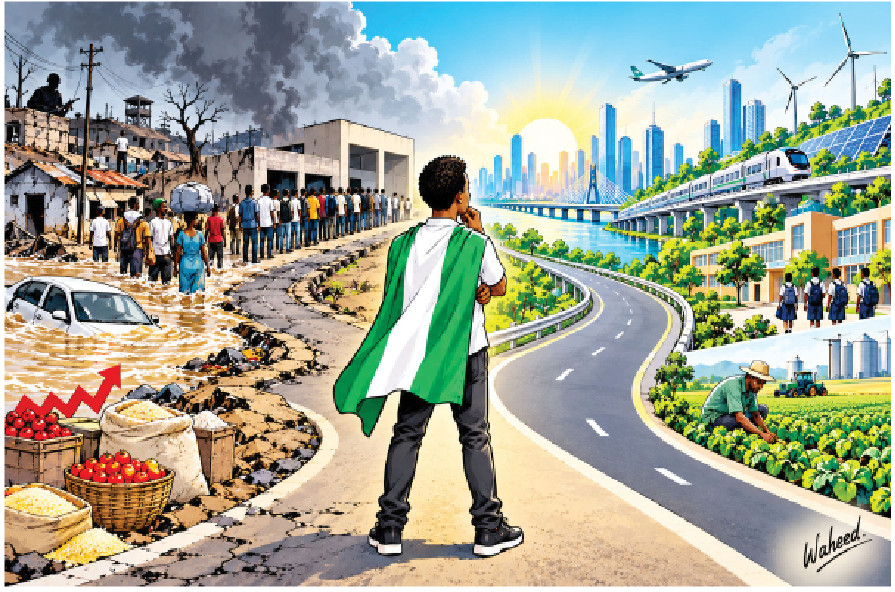
When floods swallow roads in Lagos, food prices jump in Kano, classrooms overflow in Niger Delta communities, or young graduates queue for scarce jobs in Abuja, government is expected to respond. But the deeper policy question is what happened before the emergency became visible. Nigeria often mobilises after the warning has become damage. Drainage receives attention after flooding; food interventions follow price shocks; security operations expand after insecurity has spread. The recurring weakness is not only implementation. It is anticipation.
I encountered this discipline while studying Futures Studies at Stellenbosch University’s Institute for Futures Research under André Roux and Morné Mostert. Roux sharpened my understanding of trends and structural change; Mostert pushed systems, interdependence, blind spots and unintended consequences. Their lesson was that foresight or futures thinking is not prophecy. It explores plausible futures, tests assumptions and helps decisions remain useful when tomorrow refuses to resemble yesterday.
The Tyranny of Now
Nigeria’s policy environment is unusually vulnerable to the tyranny of now. Annual budgets, five-year political horizons, sudden revenue pressures and recurring emergencies encourage short-term fixes. Yet the demographic clock moves differently. UNFPA estimates Nigeria’s population at 237.5 million in 2025, with 41 percent below 15 and 34 percent aged 10 to 24. That means millions of Nigerians will soon require education, skills, jobs, housing, transport and healthcare. These are connected pressures on one national system. Nigerian policymakers must think ahead, think across and then think again.
Education makes the point. Nigeria has spent years debating access, teacher quality, examinations and infrastructure, important concerns. But another question is unavoidable: what happens to Nigerian graduates when artificial intelligence changes entry-level work in banking, accounting, customer service, software, media and administration? A young population can become an economic advantage, but only if education and labour markets evolve together. Otherwise, demographic strength can become demographic pressure. Horizon scanning helps government examine these possibilities before they become labour-market statistics.
Read the Periphery
Peter Schwartz’s scenario-planning tradition asks policymakers to examine forces that could produce different futures. For Nigeria, this means looking beyond the headline indicator. A rise in food prices may signal more than inflation. It may reflect insecurity restricting cultivation, climate stress reducing yields, high transport costs, currency pressures and weak storage systems interacting at once. A growing number of young people leaving rural areas may be more than migration. It may signal changing agricultural labour, urban pressure and new patterns of political economy.
This is why Nigerian institutions need to distinguish signal from noise, trend from fad and weak signal from structural change. Consider digital payments, smartphones and artificial intelligence. Each began as something that could be underestimated. Today, each affects how Nigerians work, trade, communicate or access services. The lesson is not that every new development becomes transformational. It is that government needs a routine for noticing what is changing at the periphery before it becomes impossible to ignore.
Think in Systems
Agriculture shows the cost of fragmented thinking. The World Bank says agriculture accounts for nearly a quarter of Nigeria’s GDP and employs more than a third of its population, while less than 1 percent of farmland is irrigated. Yet agricultural policy is inseparable from insecurity, rainfall, water, roads, storage, energy, land access, markets and household purchasing power. Asking only how to increase production misses the system. The better question is: what agricultural system remains productive when climate, security, prices and demographics change?
The same logic applies to infrastructure. A new road can improve mobility, but if settlement expands without land-use planning, the investment can create new congestion. A flood-control project can protect one location while shifting water elsewhere. More electricity generation does little for productivity if distribution remains unreliable or firms cannot afford power. Scenario stress-testing forces policymakers to examine second-order effects, feedback loops, tipping points and unintended consequences before assuming that a project will perform as designed.
Cities Need Long Memories
Lagos offers Nigeria’s clearest test of urban foresight. Its growth is not simply a housing problem or transport problem. It is a combined question of population, wetlands, drainage, mobility, land values, employment, energy and climate resilience. Planning Lagos one project at a time can produce infrastructure without producing a coherent city. The question is what Lagos should remain capable of doing in 2045, then working backwards to the choices required today.
Kano requires a different foresight conversation. Its future cannot simply be modelled on Lagos. Heat, water availability, food systems, urban expansion, agricultural markets and the relationship between city and surrounding settlements deserve long-range scenario work. Singapore’s Urban Redevelopment Authority offers a useful institutional lesson: its Long-Term Plan looks 50 years and beyond, while its Master Plan translates that direction into a 10-to-15-year framework reviewed every five years. Nigeria need not copy Singapore. It can learn the value of linking long horizons to adaptable plans.
Institutionalise the Future
Nigeria has begun moving in this direction. The Office of the Vice President, through the Office for Strategic Preparedness and Resilience, has worked with UNICEF on Nigeria 2050 Child Foresight, applying horizon scanning and scenario planning to education, livelihoods, security, climate resilience and governance. The significance is institutional: Nigeria is already experimenting with methods for asking what different futures could mean for children and national development. The challenge is moving foresight from individual projects into the routine machinery of government.
That requires a national strategic foresight architecture. A council linking the Presidency, National Assembly, states, universities, private sector and civil society could identify major uncertainties and emerging risks. Ministries could establish foresight units. Major infrastructure and social programmes could publish their assumptions, test them against several scenarios and identify early-warning indicators. Public-service institutions could teach systems thinking, scenario development, backcasting, red-teaming and futures literacy. The objective is not another committee. It is a different decision-making habit.
Make Uncertainty Useful
Nigeria also needs uncomfortable questions on the table. What happens if oil revenues decline faster than expected? What happens if artificial intelligence reduces demand for some entry-level professional work? What happens if climate migration changes the geography of Nigerian cities? What happens if food insecurity increasingly intersects with insecurity? What happens if Lagos’s ecological vulnerability becomes an economic vulnerability? What happens if Kano develops a climate-resilient agro-urban economy that creates opportunities outside the sectors captured by today’s statistics?
These questions are not predictions. They are stress tests. That distinction matters. Futures thinking does not ask government to guess correctly. It asks government to prepare intelligently across uncertainty. It encourages policymakers to identify assumptions, monitor signals and change course when evidence changes. In a country as large, young, diverse and exposed to shocks as Nigeria, that is not an academic luxury. It is a development capability.
The practical agenda is therefore straightforward. Make scenario stress-testing part of policy appraisal. Require ministries and states to maintain horizon-scanning routines. Separate spending that solves an immediate problem from investment that preserves future options. Build long-range spatial strategies for Lagos, Kano and other rapidly growing cities. Strengthen foresight capacity in universities and public institutions. Most importantly, reward policymakers not only for responding quickly, but for seeing earlier. Nigeria cannot predict the future, but it can become less surprised by it.
We’ve got the edge. Get real-time reports, breaking scoops, and exclusive angles delivered straight to your phone. Don’t settle for stale news. Join THISTIMES on WhatsApp for 24/7 updates →
Join Our WhatsApp Channel