When Abdullahi Sule assumed office on May 29, 2019, Nasarawa State barely featured in conversations about Nigeria’s economic future.
In investment circles, it was politely described as a civil service state. In economic terms, it was a paradox: one of the most geologically endowed states in Nigeria, yet one of the most dependent on monthly federal allocation to pay salaries.
Seven years later, that story has changed — fundamentally and, perhaps, irreversibly.
Today, Nasarawa is not just digging minerals; it is processing them. It is not just inviting investors to visit; it is getting them to stay, build, and expand. It is no longer just a dot on the solid minerals map; it is becoming the map itself. In a country desperate for diversification, Nasarawa is offering a working template for how a subnational can move from potential to production.
This transformation did not happen by accident. It happened by design.
The Blueprint Before the Brick
Most administrations in Nigeria start with projects — roads, bridges, buildings to commission before the next election cycle. Sule started with a document.
Shortly after assumption of office, he launched the Nasarawa Economic Development Strategy (NEDS). At the time, many dismissed it as another glossy policy document destined for a shelf in Lafia. Policy documents are abundant in Nigeria; policy discipline is not.
NEDS became different because it was enforced. It provided a clear economic direction: to make Nasarawa one of the top three most competitive states to do business in Nigeria, to move from a consumption-based civil service economy to a production-based industrial economy, and to leverage private capital as the driver.
To give that document teeth, Sule strengthened the Nasarawa Investment and Development Agency (NASIDA) as a genuine one-stop shop — not just for investor handshakes and photo ops, but for land administration, regulatory clarity, and aftercare. He understood from his decades in the boardroom at Dangote and other multinationals a simple truth that eludes many in government: capital does not go where it is needed; it goes where it is safe, welcomed, and profitable.
That clarity is why investors have kept coming, even when national headwinds — currency volatility, insecurity, and policy uncertainty — have slowed investment elsewhere.
The Lithium Revolution
Nowhere is Sule’s model more evident than in the lithium fields of Nasarawa. For decades, Nigeria’s solid minerals story has been a story of waste. We export raw ores for a pittance, only to import finished products at a premium. We export jobs and import poverty. Over 44 different solid minerals exist in commercial quantities across the country, but mining has contributed less than 1% to GDP for years because we refused to add value.
Sule insisted on a different bargain in Nasarawa: if you want our lithium, you must process it here.
The results have been historic, and they have come in quick succession.
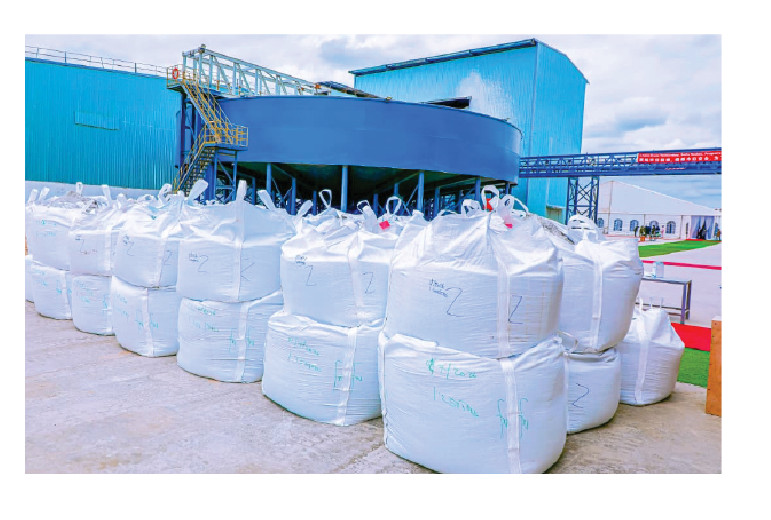
In May 2024, President Bola Ahmed Tinubu, represented by Senate President Godswill Akpabio, commissioned the Avatar New Energy Materials Co. Ltd plant in Kama Otto, Nasarawa Local Government Area. With a capacity of 4,000 metric tonnes per day, it was celebrated as Nigeria’s first lithium value-addition plant, with a projection of 4,000 direct and indirect jobs.
That record was short-lived.
Last month, President Tinubu, represented by Vice President Kashim Shettima, commissioned the Diamond New Energy lithium processing plant in Endo, Nasarawa LGA. Built by Chinese firm Diamond New Energy in partnership with the Nasarawa State Government, and in collaboration with Jiuling and Canmax — two global giants in battery materials — the $250 million facility processes 6,000 metric tonnes per day, or about 3 million tonnes annually. It is the largest lithium processing plant in Africa and West Africa, and it is designed to soon commence mass production of lithium batteries, the critical component powering the global electric vehicle revolution.
This is not an isolated story. It is a cluster in the making.
In Udege Mbeki, Kokona LGA, Kenyang Mining is mining tin. In Awe, Multiverse Mining and Exploration is mining zinc and lead. In Wamba, Matrix Energy is setting up a tin processing factory. This is how industrial hubs are built — not by one factory, but by a concentration of related industries that feed off each other, share infrastructure, skills, and logistics.
Nasarawa is no longer just a mining site. It is a manufacturing cluster.
The Numbers Don’t Lie
The most convincing argument for Sule’s model is not in commissioned plaques or ribbon-cutting ceremonies. It is in the state’s books.
In January, the Commissioner for Finance, Hajiya Munirat Abdullahi, disclosed that Nasarawa generated over N52 billion as Internally Generated Revenue (IGR) in 2025, and that the state now targets N5 billion monthly to hit N60 billion in 2026. She was explicit about the source of the surge: royalties and haulage revenues from solid minerals — a direct dividend of the industrialization drive.
That figure represents a dramatic leap from the N7 billion IGR the state generated in 2019 when Sule assumed office. Even more conservative assessments from NASIDA presentations put the growth at N37 billion in 2025 — still a fivefold increase. Whichever figure you use, the trend is unmistakable: upward, and driven by productivity, not taxation of poverty.
NASIDA’s investment portfolio tells the same story. The agency, which Sule deliberately positioned as the engine room of the state’s economic diplomacy, has in 2025 alone been linked to over $1 billion in domestic and foreign investment interests, with over $500 million already actualized. Previous years saw inflows in excess of $500 million to $1.2 billion depending on assessment methodology.
The investor list is instructive: Infinitum Energy Group (USA) with a 25-30MW waste-to-energy project, Cenpower Generation with 50MW hydropower, EMK Group of Turkiye in agriculture value chain, FarmTrac Tractors, Olam, Dangote Sugar, Flour Mills of Nigeria, and Green Sahara Farms. These are not portfolio investors looking for quick returns; these are brick-and-mortar investors pouring concrete.
The jobs story follows the investment story. According to the state, over 50,000 jobs have been created through these investments, both directly and through the value chain.
More Than Mining: A Lesson in Statecraft
It would be a mistake to reduce Sule’s Nasarawa experiment to lithium alone.
What he has done is more fundamental: he has shown how to formalize an informal economy. For years, solid minerals in Nasarawa — like in Zamfara, Osun, and Plateau — were synonymous with illegal mining, child labour, environmental degradation, and insecurity.
Sule’s approach was not to chase artisanal miners with task forces alone, but to group them into cooperatives, register them, and bring them into the tax net.
It is a data-based approach, as his Finance Commissioner put it — one that improves revenue while also improving security and environmental oversight. It is also a lesson in political will: insisting on value addition is easy to say, but it requires confronting powerful interests who have made fortunes from exporting raw minerals.
There is also a lesson in continuity. NEDS was not abandoned after one year. NASIDA was not made redundant after the first investment summit. The same message — Nasarawa is open for business, but on terms that benefit Nasarawa — has been consistent for seven years. Investors, like all human beings, respond to consistency.
The Road Ahead
To be clear, Nasarawa is not yet an industrial Eldorado. The state still faces significant challenges: rural roads to evacuate produce and minerals, power to keep factories running, skills to keep young people employable, and the environmental costs that come with mining. The lithium boom, if not carefully managed, could become the oil curse in miniature — polluted communities, restive youth, and wealth that does not trickle down.
Sule’s team appears aware of this. The insistence on community engagement, environmental protection — which President Tinubu himself emphasized at the commissioning ceremonies — and the linkage to agriculture through firms like Olam and Dangote Sugar, suggest an attempt to avoid a mono-economy within the state.
But the larger lesson for Nigeria is already clear.
What Governor Sule has proven is that Nigeria’s economic diversification does not have to wait for Abuja to get its act together. It can start in the states. It can start with a clear strategy, a credible institution to drive it, and a governor who understands the language of the private sector.
In an era where many states still lament dwindling federal allocation and borrow to pay salaries, Nasarawa is charting a path to financial self-sufficiency — not by chance, not by federal favour, but by a clear-eyed strategy executed with private-sector discipline.
The lithium in Endo may power electric cars in Berlin and Beijing tomorrow. But today, it is powering something far more important: jobs in Keffi, revenue for Lafia, and hope that Nigeria can finally benefit from what lies beneath its soil.
If this quiet revolution in the North-Central continues, history may well record that Nigeria’s industrial future did not start with a big bang in Lagos or Abuja, but with a well-thought-out strategy document in Lafia.
We’ve got the edge. Get real-time reports, breaking scoops, and exclusive angles delivered straight to your phone. Don’t settle for stale news. Join THISTIMES on WhatsApp for 24/7 updates →
Join Our WhatsApp Channel